Universal Shaft And Continuous PU Sandwich Panel Line Combination Suitable For Panels Production
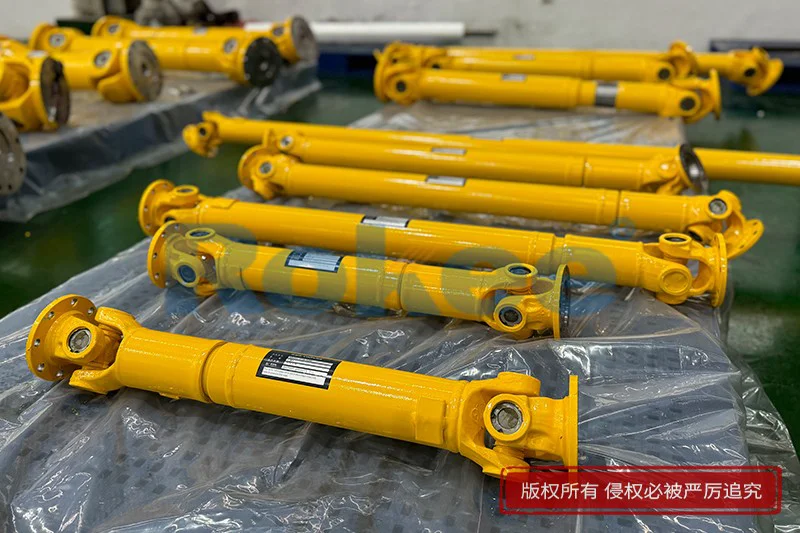
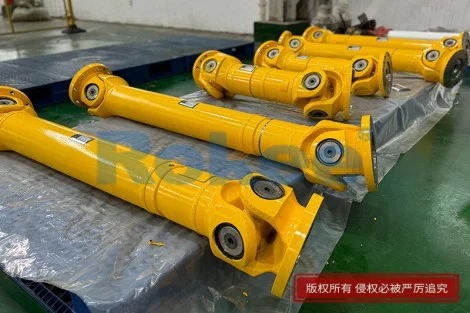
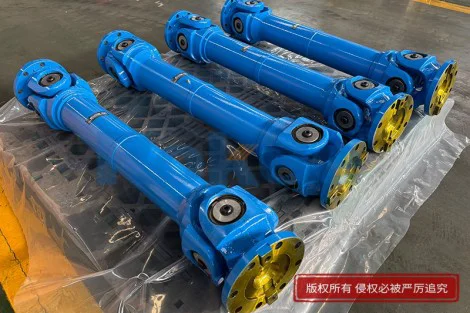
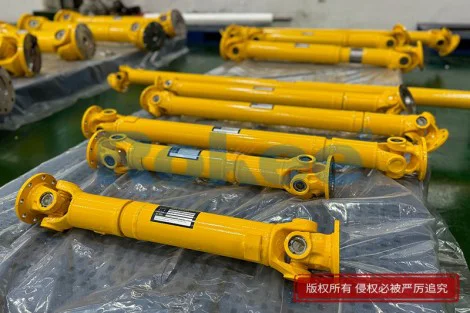
A universal shaft, when integrated into a continuous PU sandwich panel line, acts as the mechanical bridge that transmits torque from the main drive units to the rotating elements of the production machine while accommodating misalignment between connected shafts. In the context of panel manufacturing, this component is not a single isolated part but a carefully engineered assembly of universal joints, telescopic tubes, bearing housings, and locking mechanisms that together ensure smooth, uninterrupted power delivery across the length of the line. The continuous PU sandwich panel line itself is a highly integrated production system designed to manufacture insulated panels in an unbroken sequence, where two metal facing sheets are unwound, coated with adhesive, foamed with polyurethane core material, and bonded together in a controlled pressure and temperature environment before being cut to length and stacked. The synergy between the universal shaft system and the continuous line lies in the fact that the line's many driven rollers — from the uncoiler mandrels and the pre-punching stations to the double belt laminator and the edge trimming saw — must all rotate in precise synchronization, yet their physical positions shift slightly due to thermal expansion, foundation settling, and adjustment operations. The universal shaft absorbs these small angular and axial variations without causing vibration, binding, or premature wear, which is essential for maintaining the flatness, bond strength, and dimensional accuracy of the finished sandwich panels. Without a properly specified universal shaft arrangement, the continuous line would suffer from inconsistent web tension, uneven foam distribution, and eventual mechanical fatigue, all of which directly degrade the quality of the panels coming off the end of the line. This combination of flexible power transmission and continuous process flow represents one of the foundational architectural decisions in modern panel plant design, and understanding how these two elements interact is key to evaluating any production setup.
The continuous PU sandwich panel line operates on the principle that panel quality is best achieved when the entire forming process occurs in a single, uninterrupted pass rather than through batch or semi-continuous steps. At the entry end of the line, coils of pre-painted steel or aluminum facing are loaded onto dual uncoiling stations, allowing one coil to run while the next is prepared and spliced, ensuring that the line never stops for coil changes. The facing then passes through a series of preparation stations where protective film is applied, surface oils are applied if needed, and the sheet is pre-notched or embossed according to the panel profile. From there, the sheet enters the foam injection area, where a mixture of polyol and isocyanate is precisely metered and sprayed onto the moving lower facing. The upper facing, running in parallel from its own uncoiler, joins the lower sheet in the double belt press, where the two facings sandwich the chemically reactive foam. Inside the double belt, which is typically heated and cooled in sequential zones, the polyurethane expands, cures, and forms a rigid, bonded composite panel with consistent density throughout its cross-section. The universal shafts in this system drive the conveyor belts, the feed rollers, and the thickness adjustment screws that define the final panel gauge. Because the line can stretch to over one hundred meters in length, the distance between the gearbox output and the roller input varies by several centimeters, and the telescoping universal shaft handles this axial displacement automatically. The continuous motion means that every meter of panel experiences nearly identical processing conditions, which is why continuous lines are preferred over discontinuous batch systems for high-volume commercial and industrial panel production. The elimination of start-stop cycles also reduces material waste at the head and tail of each production run, a significant economic consideration when foam chemicals and coated coil are both expensive inputs.
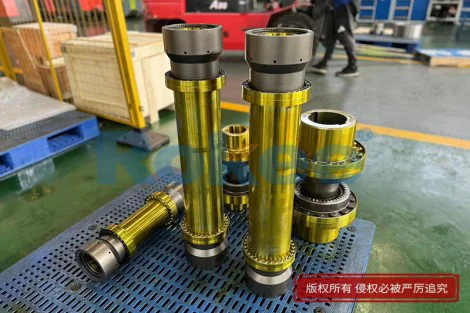
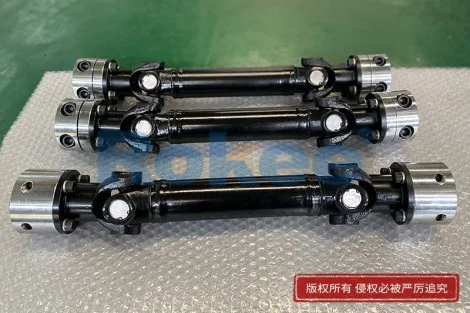
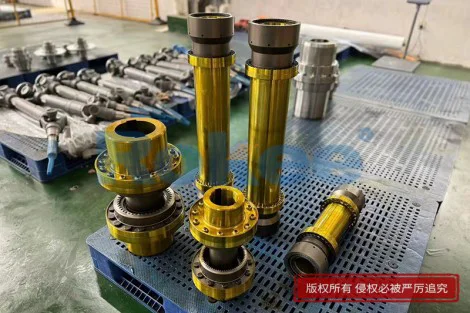
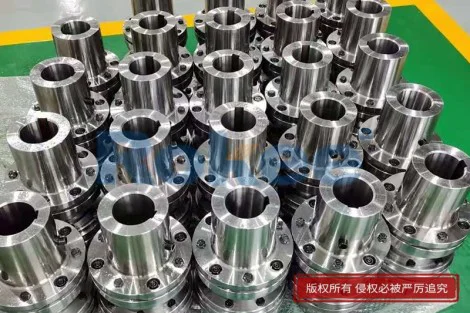
The universal shaft components within this line must be selected for high torsional rigidity while maintaining a reasonable degree of angular flexibility. Most industrial panel lines use double universal joint arrangements, where two universal yokes connected by a telescopic intermediate shaft allow angular compensation at both ends. The yokes are typically forged from alloy steel and machined to tight tolerances, with needle roller bearings pressed into the bearing caps to reduce friction under high torque. The telescopic section usually consists of a splined or hexagonal profile that slides axially, allowing the shaft to lengthen or shorten as the driven roller moves during thickness adjustments or belt tracking corrections. In the context of a PU sandwich panel line, these adjustments happen frequently: when switching from a 50-millimeter panel to a 100-millimeter panel, the upper belt of the laminator must be raised, which changes the center-to-center distance between the drive sprocket and the belt roller. The universal shaft accommodates this change in real time without requiring mechanical disassembly, which is what allows the line to change over between product sizes with minimal downtime. The universal joints also dampen torsional fluctuations from the drive motor, smoothing out torque spikes that could otherwise cause belt jerking or surface imperfections on the panel. Lubrication of the universal joint bearings is critical; most modern lines include automatic grease distribution systems that feed lubricant through internal channels in the shaft, preventing dry running and extending service life. The combination of high torque capacity, angular misalignment compensation, axial length adjustment, and torsional damping makes the universal shaft an indispensable element of the continuous line's mechanical architecture, and its proper specification directly influences both line reliability and final panel quality.
The production of PU sandwich panels requires extremely precise control over the chemical reaction that forms the polyurethane foam, and the continuous line environment provides the stable platform needed for this control. Polyurethane foam is created when polyol resin reacts with isocyanate in the presence of blowing agents, catalysts, and surfactants. The reaction begins immediately after the two components are mixed in the high-pressure impingement mixing head, which travels back and forth across the width of the lower facing as the panel moves forward. The foam starts as a liquid froth, expands to many times its original volume, and then cures into a rigid cellular structure. The speed at which this reaction proceeds depends on temperature, chemical formulation, and the density target of the final panel. The continuous line's double belt press is designed so that the foam has exactly the right amount of time to rise and cure before the panel exits the press and reaches the cutting station. If the line speed is too fast, the foam may not fully cure, resulting in soft core material and poor dimensional stability. If the line speed is too slow, the foam may over-cure before reaching the profile forming section, causing bond failure or surface cracking. The universal shafts driving the conveyor belts must therefore maintain extremely consistent rotational speed, because any speed variation directly translates to variation in dwell time inside the laminator. The drive system typically uses variable frequency motors connected through planetary gearboxes to the main drive rollers, with the universal shafts transmitting power from the gearbox output to the roller input. Encoder feedback loops compare the actual line speed against the setpoint and adjust motor output continuously. The universal shaft's torsional stiffness ensures that this feedback loop works effectively, because any wind-up or backlash in the shaft would introduce a phase lag that degrades speed regulation. The result is a panel whose foam density is uniform across both length and width, whose bond strength between facing and core meets structural expectations, and whose thermal insulation performance is consistent from the first panel of the shift to the last.
The continuous PU sandwich panel line combines several process stages into a single integrated flow, and each stage places different demands on the universal shaft system. The uncoiling stage requires constant tension control, because the facing coil must feed into the line at a steady rate without stretching or wrinkling. The drive motors for the uncoilers use load cells to measure web tension, and the universal shafts transmit the braking or driving torque to the mandrel. The pre-processing stations, which may include embossing rollers, edge notching dies, or perforating tools, impose intermittent shock loads as the profile tools engage and disengage with the facing sheet. The universal joints must absorb these shocks without transmitting them back to the main drive train, which is why shock-absorbing universal shaft designs with elastomeric elements are sometimes specified for these intermediate stations. The foam injection and laminating section, as described earlier, demands steady, vibration-free rotation of the double belt. The exit end of the line includes edge trimming saws, which cut the panel edges to the exact width, and a cross-cutting saw that traverses with the panel to cut it to the specified length while the line keeps moving. The flying saw mechanism uses universal shafts to drive its feed rollers and cutting blade, because the saw carriage must move along linear rails in sync with the panel. After cutting, panels are conveyed to a stacking station where automatic stackers pick them up and arrange them on pallets. The universal shafts at each of these stations are sized according to the torque requirements of that specific position — the laminator drive sees the highest continuous torque, the saw drive sees intermittent high torque, and the uncoiler sees gradually decreasing torque as the coil depletes. This distributed approach to power transmission, made possible by universal shafts at each driven point, is what allows a single long line to operate as a coordinated system rather than a collection of independent machines.
The universal shaft and continuous line combination also delivers significant advantages in terms of panel dimensional consistency and surface quality. Because the panel moves continuously through the laminator, the pressure applied by the double belt is uniform along the entire length of the panel, unlike in a batch press where pressure is applied only at the ends or in segments. This uniform pressure ensures that the bond between the metal facing and the foam core is consistent, eliminating weak spots that could lead to delamination in service. The surface of the metal facing, which may have a decorative coating or embossed pattern, remains flat and wrinkle-free because the web tension is maintained at a constant level by the driven rollers, each connected through a universal shaft that compensates for minor misalignments. The edge quality of the panel is also improved, because the trimming saw operates continuously on a moving web rather than on a stationary panel, producing a clean, square edge without burrs or deformation. The dimensional tolerances achievable on a well-tuned continuous line are tight enough for the panels to be used in modular building systems, where panels must interlock precisely with supporting structures. The universal shafts play a quiet but essential role in this dimensional consistency, because they ensure that all the driven rollers in the line rotate at exactly the correct speed and without vibration. Even small vibrations in a roller can create ripples on the metal facing or uneven foam density, which would be visible on the finished panel surface and would reject the panel at quality inspection. By providing smooth, balanced power transmission, the universal shaft system contributes to the overall surface quality that customers expect from premium PU sandwich panels, whether they are destined for cold storage rooms, clean room facilities, industrial warehouses, or prefabricated building envelopes.
The flexibility of the universal shaft design also enables the continuous line to handle a range of panel thicknesses and widths without major mechanical reconfiguration. A typical PU sandwich panel line may need to produce panels ranging from 30 millimeters to 200 millimeters in thickness, and widths from 1000 millimeters to 1200 millimeters or more. When changing thickness, the upper belt of the laminator must be raised or lowered, and the universal shaft connecting the belt drive to the roller automatically telescopes to accommodate the new center distance. When changing width, the foam injection head travels a different path, and the side guide rollers are repositioned; the universal shafts driving these side rollers may need slight angular adjustments, which the universal joints handle without modification. This flexibility means that a single continuous line can serve multiple market segments — from thin decorative wall panels to thick insulated roof panels — without requiring dedicated machines for each product type. The changeover process itself is accelerated because many adjustments are now motorized, with the operator entering the new panel dimensions through the line's human-machine interface and the control system automatically positioning the thickness screws, side guides, and cutting lengths. The universal shafts in these adjustment drives must be capable of starting and stopping frequently, because each positioning move involves a short drive cycle followed by a pause. The needle roller bearings in the universal joints are designed for these intermittent duty cycles, and the lubrication system is sized accordingly. The ability to quickly switch between panel specifications reduces the economic risk of running a continuous line, because the plant can respond to customer orders of varying sizes without long setup times. This versatility, enabled in part by the universal shaft's ability to adapt to changing mechanical geometries, is one of the reasons continuous PU sandwich panel lines have become the standard for high-productivity panel manufacturing worldwide.
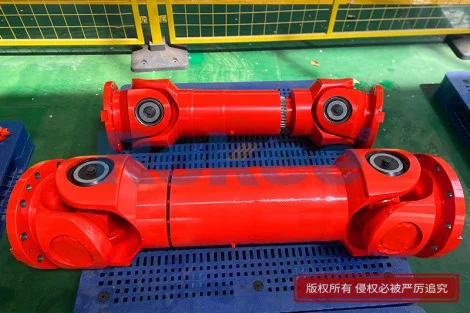
Maintenance and reliability considerations are central to the long-term performance of the universal shaft and continuous PU sandwich panel line combination. In a production environment that may run two or three shifts per day, six days per week, every rotating component is subject to continuous wear. Universal shafts, being articulated joints with moving parts, are among the more maintenance-intensive elements of the line. Operators and maintenance technicians follow scheduled inspection routines that include checking shaft alignment, verifying grease levels, examining the rubber boots around the universal joints for cracks, and listening for unusual knocking or grinding noises during operation. A failed universal joint on a critical drive — such as the main laminator belt — would cause an immediate line stop, potentially ruining dozens of panels in the process and costing hours of production time. For this reason, most plants keep spare universal shafts on hand for the most critical positions, allowing a quick swap-out during a scheduled maintenance window rather than waiting for a failure. The continuous line itself is designed with maintainability in mind: access platforms surround the long laminator section, safety interlocks prevent access during operation, and the drive components are mounted on open frames rather than enclosed cabinets to allow visual inspection. The universal shafts are often painted in high-visibility colors to make them easy to locate during maintenance walks. Predictive maintenance techniques, such as vibration analysis and thermography, are increasingly used to monitor the health of the universal joints and bearings, detecting early signs of wear before they lead to catastrophic failure. The combination of robust mechanical design, accessible maintenance points, and condition-based monitoring ensures that a well-equipped continuous PU sandwich panel line can achieve utilization rates of eighty percent or higher, a figure that directly determines the economic output of the plant. The universal shaft, though a relatively small component in the overall line, punches above its weight in terms of reliability impact, and its proper care is essential to protecting the substantial investment represented by the continuous line.
The quality control systems integrated into a modern continuous PU sandwich panel line work hand in hand with the mechanical drive arrangement to ensure that every panel leaving the line meets the required specifications. Along the length of the line, sensors measure panel thickness using laser triangulation, detect surface defects using machine vision cameras, and monitor foam density using gamma or infrared gauges. These sensors feed data back to the central control system, which adjusts line speed, foam output, belt temperature, and pressure settings in real time. The universal shafts that drive the conveyor belts must respond predictably to these control adjustments, because a change in line speed must be reflected immediately at every point along the web. Any slippage or wind-up in the universal shaft would cause a mismatch between the sensor reading at one station and the actual panel position at the next, leading to incorrect trimming or cutting. The control system also tracks panel length as it exits the cross-cut saw, verifying that each panel has been cut to the ordered dimension. Statistical process control charts are generated automatically, showing trends in thickness, width, length, and bond strength over time. The universal shafts contribute to this quality data indirectly but significantly: by ensuring smooth, consistent rotation, they eliminate mechanical sources of variation that would otherwise be mistaken for process variations and would lead to unnecessary adjustments. At the end of the line, finished panels are automatically stacked, wrapped, and labeled with production data including batch number, production time, and panel specification. Traceability is important for panel manufacturers, because if a defect is discovered in the field, the plant needs to be able to trace it back to a specific production run, chemical batch, and line setting. The continuous line's ability to produce a fully integrated, data-rich product trace, supported by reliable mechanical transmission through universal shafts, gives both the manufacturer and the end customer confidence in the quality of the PU sandwich panels.
Looking forward, the combination of universal shaft technology and continuous PU sandwich panel production line continues to evolve in response to market demands for higher productivity, lower energy consumption, and more sustainable panel products. Drive systems are becoming more integrated, with gear motors that combine the motor, gearbox, and drive electronics in a single compact unit, reducing the number of universal shaft connections needed and minimizing potential failure points. However, universal shafts remain essential in positions where the driven element must move relative to the fixed drive, such as the floating end of the laminator belt or the traversing flying saw. Material science advances are producing stronger, lighter, and more wear-resistant universal joint components, allowing shafts to transmit higher torque at lower weight and with longer service intervals. The continuous lines themselves are being optimized for energy efficiency, with heated belt zones using more efficient insulation and waste heat recovery systems, and with variable frequency drives that match power consumption to actual line speed. The foam chemistry is also evolving, with new blowing agents that have lower environmental impact and improved thermal performance, and these new chemistries sometimes require slightly different temperature and speed profiles in the laminator. The universal shaft system, being mechanically robust and adaptable, does not need to change when the chemical formulation changes; it simply continues to transmit power smoothly regardless of what foam recipe is being run. This mechanical independence from process chemistry is one of the strengths of the universal shaft and continuous line combination. As the building envelope industry continues to demand higher-performing insulated panels, and as panel manufacturers seek to maximize output from their capital equipment, the synergy between flexible mechanical power transmission and continuous process flow will remain at the heart of efficient PU sandwich panel production. The universal shaft may be a humble component, but in the context of a fully integrated continuous line, it is the silent workhorse that keeps the panels moving smoothly, consistently, and profitably from raw coil to finished product.