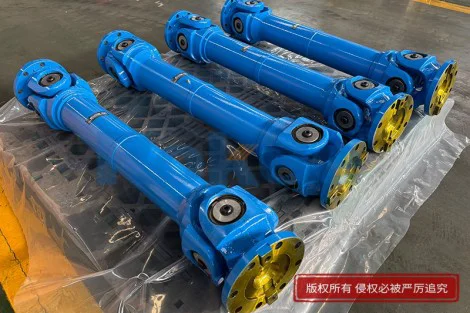
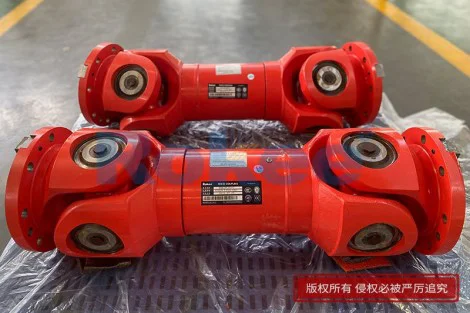
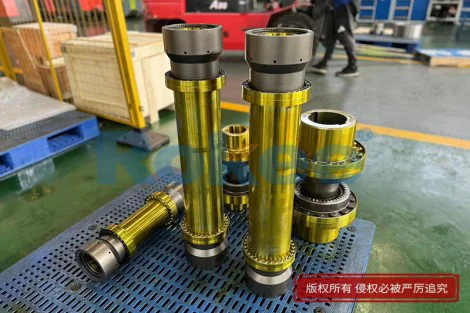
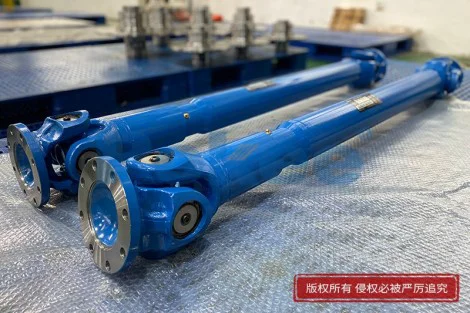
High-precision Transmission Universal Shaft Empowers The Upgrading Of Continuous PU Sandwich Panel Line

In the fast-evolving landscape of modern building materials manufacturing, the continuous PU sandwich panel line stands as one of the most sophisticated and demanding production systems ever devised. These integrated production lines, which bond a rigid polyurethane core between two facing sheets at speeds that can exceed fifteen meters per minute, depend on a cascade of mechanical, chemical, and thermal processes that must remain synchronized to within fractions of a millimeter and fractions of a second. At the very heart of this intricate ballet lies the transmission system—a network of shafts, couplings, bearings, and gearboxes that transfers rotational power from motors to the forming rollers, conveyor belts, cutting saws, and stacking stations that shape the final panel. Among these transmission components, the universal shaft occupies a position of particular strategic importance: it bridges motorized drive units to roller assemblies that may sit at slightly offset angles, misaligned distances, or dynamically shifting positions as the line adjusts for different panel thicknesses and widths. A conventional universal joint, while functional, introduces subtle backlash, angular velocity fluctuation, and torsional wind-up that propagate through the entire line, manifesting as uneven foam density, wavy facing lamination, dimensional drift, and premature tooling wear. It is precisely this set of hidden limitations that has driven the industry toward high-precision transmission universal shafts—components engineered not merely to transmit torque, but to do so with near-zero angular error, exceptional torsional rigidity, and long service life under continuous-duty conditions. As manufacturers worldwide push toward faster line speeds, tighter tolerances, and thinner yet stronger panels, the upgrade from standard universal joints to high-precision universal shafts has emerged as one of the most cost-effective and impactful modernization investments available.
The continuous PU sandwich panel production process itself is a study in controlled chaos. Raw steel or aluminum coils are decoiled, leveled, profiled, and preheated before entering the foaming section, where a two-component polyurethane mixture is sprayed and chemically reacts between the two facing sheets. The entire sandwich then passes through a long, temperature-controlled double belt oven where the foam rises, cures, and bonds to the facings under uniform pressure. After exiting the oven, the panel travels through a tracking and cutting station that severs it to exact customer-specified lengths, then moves to a flip-stack or auto-stacking area where finished panels are collected, bundled, and prepared for shipment. Throughout this journey, every roller, conveyor, and driven component must rotate at precisely coordinated speeds. If the feed roller at the entry pulls slightly faster than the conveyor inside the oven, the facing sheet wrinkles or stretches. If the exit belt lags, the cured foam compresses unevenly or the panel bows. Even tiny speed mismatches—on the order of half a percent—can translate into measurable quality defects over a panel that runs ten meters long and travels at hundreds of meters per hour. This is where the universal shaft earns its keep: because drive motors and gearboxes are often mounted on fixed frames while the rollers they drive sit on adjustable bearing blocks, sliding bases, or pivoting lever arms, a rigid shaft cannot accommodate the offset. A universal shaft must bridge that offset while faithfully transmitting rotational motion. The quality of that transmission—how perfectly the output angle mirrors the input angle, how little torsional deflection occurs under load, how smoothly torque is delivered through varying operating angles—becomes the invisible hand that either stabilizes the entire line or introduces a persistent, low-level vibration that engineers struggle to diagnose.
Traditional universal joints, commonly of the cross-and-bearing or jaw-and-clevis variety, have served industry for over a century, but they carry inherent geometric limitations. A single Cardan universal joint, when operating at an angle, produces a characteristic non-uniform angular velocity: the driven shaft speeds up and slows down twice per revolution, even when the driving shaft rotates at constant speed. This fluctuation, expressed mathematically as a function of the operating angle squared, is small at shallow angles but becomes pronounced as soon as the shaft is called upon to accommodate meaningful misalignment. In a continuous PU panel line, where the forming rollers must maintain constant surface speed to avoid shearing the still-soft foam, this pulsation is anything but benign. It creates micro-variations in sheet tension, which ripple into the foam chemistry and cause density banding across the panel width. Over time, the needle bearings inside conventional joints develop clearance, introducing backlash that shifts timing between sections of the line. Lubrication points multiply, seals wear, and the joint itself becomes a maintenance hotspot—often the first component to fail on a line that otherwise runs around the clock. High-precision transmission universal shafts address these issues at the design level. By using paired universal joints arranged as a constant-velocity assembly, by precision-grinding the yokes and cross trunnions, by specifying needle bearings with reduced radial clearance, and by stiffening the tube section against torsion, these shafts eliminate the angular velocity ripple and slash the torsional wind-up that plagues standard units. The result is a drive train that transmits motion almost as though the input and output shafts were rigidly and coaxially connected.
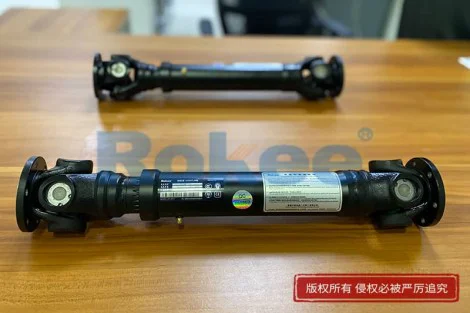
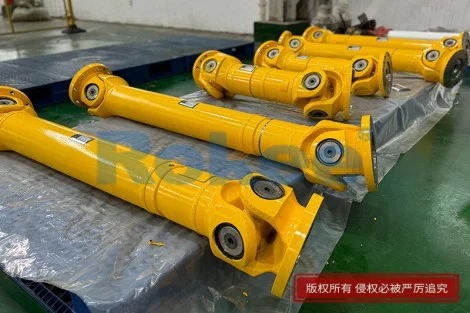
The engineering principles behind high-precision universal shafts deserve closer examination. At their core, these assemblies consist of two yoke-and-cross joints connected by a length of tubular or solid shaft, arranged in such a way that the angular accelerations of the two joints cancel each other out—producing constant velocity output even when the shaft itself operates at an angle. The precision lies in every detail: the yokes are forged and machined to tight geometric symmetry so that both joint centers lie in the exact same plane; the needle bearing races are ground to micron-level concentricity; the cross trunnions are heat-treated and honed to a surface finish that minimizes friction and fretting; and the connecting tube, often made from high-strength alloy steel, is sized to keep torsional deflection within a fraction of a degree even under peak torque spikes. Many high-precision units also incorporate splined or telescoping sections that allow axial length adjustment—critical when roller bases shift to accommodate different panel thicknesses or when maintenance requires withdrawal of the roll. The lubrication system is reimagined as well: instead of grease fittings on every joint, premium shafts use sealed-for-life bearing packs with specialized long-life lubricants, or centralized lubrication channels that deliver metered oil directly to the contact zones without disassembly. Balance is another hallmark: because these shafts spin at speeds that can reach several hundred revolutions per minute on long lines, residual unbalance would induce vibration at critical speeds. Manufacturers therefore dynamically balance each assembly, often at two planes, and mark the balance positions so that field reassembly preserves the precision. The cumulative effect is a transmission component that behaves more like a precision instrument than a heavy industrial coupling.
When such shafts are installed on a continuous PU sandwich panel line, the observable improvements begin almost immediately. Operators notice a steadier, quieter line—less rhythmic thumping in the drive section, less vibration transmitted to the frame and walkways. Quality technicians see a reduction in the minor width-wise density variations that previously required fine-tuning of chemical dosing to compensate. Maintenance logs show longer intervals between greasing, fewer bearing replacements, and fewer emergency stoppages traced to universal joint failure. But the deeper benefits are economic and strategic. Because the line can run faster within the same quality envelope, effective output increases without capital investment in additional equipment. Because panel dimensional consistency improves, scrap rates drop—often by several percentage points, which on a high-throughput line translates into thousands of square meters of saved material per month. Because the drive train is more stable, downstream cutting and stacking stations see cleaner cuts, fewer panel edge damages, and better bundle formation. Over the typical fifteen-to-twenty-year life of a PU panel line, the cumulative savings from reduced scrap, lower maintenance labor, and higher throughput far exceed the modest incremental cost of specifying high-precision universal shafts over standard ones. This is why panel line builders and retrofit specialists increasingly treat the universal shaft not as a commodity spare part, but as a precision actuator whose selection should be guided by dynamic analysis rather than catalog cross-referencing.
The upgrade journey from conventional to high-precision universal shafts is rarely a simple bolt-on swap. It begins with a careful audit of the existing drive train: measuring operating angles at every articulated joint, recording peak and average torque demands, cataloging rotational speeds, and noting the axial movements that occur during panel thickness changes. Engineers then model each shaft location in a torsional vibration analysis to identify natural frequencies, resonance risks, and the damping effect that a stiffer shaft would introduce. In many cases, the high-precision shaft, with its lower backlash and higher torsional stiffness, shifts the system's natural frequency enough to move it away from a previously problematic operating speed band—eliminating a persistent hum or vibration that operators had accepted as normal. The mechanical fit must also be verified: end flanges, splined hubs, or clamping collars need to match existing roll and gearbox interfaces, and overall shaft length envelopes must clear surrounding structures during maximum articulation. Installation itself benefits from precision alignment protocols—using dial indicators or laser alignment tools to set the driven rolls to nominal parallelism and coaxiality before fitting the shafts, rather than allowing the universal joints to absorb alignment errors they were never meant to carry. Once commissioned, the line should be observed under multiple speed and thickness setpoints, with vibration readings taken at each bearing housing, to confirm that no resonance has been introduced. When done methodically, the retrofit produces a step-change in line behavior that operators describe as transformative—almost as though a rough, gravel road had been repaved into a smooth highway overnight.
Beyond the immediate mechanical gains, high-precision universal shafts enable a new generation of line design philosophies. Modern PU panel lines are trending toward wider panels, faster accelerations, and more frequent recipe changes as customers demand greater customization—different core densities, different facing profiles, different insulation values, and increasingly, aesthetic liners with micro-perforations or embossed surfaces. Each recipe change may require roller gaps to open or close, conveyor sections to reposition, and knife depths to adjust. A transmission system that retains precision through all these reconfigurations becomes a strategic enabler rather than a constraint. High-precision universal shafts, with their telescoping sections, sealed bearings, and predictable torsional behavior, allow designers to build more adjustable, more agile lines without sacrificing synchronization. They also support the trend toward direct-drive and servo-controlled roller sections, where speed loops must close tightly and where even a degree of lost motion in the coupling would undermine the control loop's bandwidth. In effect, the universal shaft is no longer a passive bridge; it is a critical link in a closed-loop motion control system, and its stiffness and responsiveness directly determine how accurately the line can hold speed, tension, and position. Lines specified with these shafts from the outset tend to command premium resale value and attract customers who demand the tightest tolerances in architectural and cold-storage applications.
The quality management implications extend well beyond the production floor. When a line transmits motion more faithfully, the finished panels exhibit surface flatness and dimensional repeatability that justify higher prices in competitive markets. Architectural customers who specify concealed-fix panels for curtain walls, refrigeration clients who demand flat interior surfaces for hygienic environments, and construction firms who need panels that interlock without gaps—all benefit from the reduced waviness and tighter length tolerances that a stable drive train delivers. Inspection processes become easier because the defect baseline is lower; quality teams spend less time sorting marginal panels and more time on continuous improvement. Customer complaint rates fall, warranty claims shrink, and the manufacturer's reputation for consistency strengthens. From a sustainability perspective, the reduction in scrap is itself a meaningful environmental contribution: every rejected panel represents wasted chemicals, wasted metal coil, wasted energy, and wasted transport. A high-precision transmission system that lowers scrap by even one or two percentage points across a multi-line plant yields an annual material savings that is substantial in both volume and carbon footprint. As regulatory pressure on building materials manufacturers grows, and as customers increasingly demand documented product consistency, these operational gains become not just competitive advantages but prerequisites for market access. The humble universal shaft, upgraded to precision grade, thus becomes an unlikely but powerful lever for elevating an entire manufacturing organization.
Maintenance and lifecycle considerations round out the value proposition. High-precision universal shafts are designed for longer service intervals under continuous-duty conditions, which means less planned downtime, fewer spare parts in inventory, and reduced exposure to the safety risks that come with frequent heavy-equipment interventions. Sealed bearing designs eliminate the human error associated with manual greasing—both over-lubrication, which can blow seals and contaminate production areas, and under-lubrication, which causes premature brinelling. Many modern shafts also carry wear-monitoring provisions: accessible measuring points where technicians can check radial play with a dial indicator, or integrated condition-monitoring ports that feed into plant vibration systems. When a shaft does eventually approach end-of-life, its modular design allows the yokes, crosses, and tubes to be serviced or replaced individually rather than discarding the entire assembly. Predictive maintenance becomes feasible: trending vibration signatures over months reveals a gradual increase in harmonic content that signals incipient bearing wear, allowing replacement to be scheduled during a planned window rather than triggered by an unplanned failure. This shift from reactive to predictive maintenance is one of the quiet revolutions in continuous panel plants, and it depends on transmission components that behave consistently enough for their degradation to be distinguishable from normal baseline variation. The high-precision universal shaft, by starting from a low-vibration, low-backlash baseline, provides exactly the clean signal that condition-monitoring algorithms need.
In the broader arc of industrial progress, the continuous PU sandwich panel manufacturing line represents a mature technology that nonetheless continues to evolve—driven by taller buildings, stricter energy codes, lower-carbon construction methods, and the relentless demand for faster, cheaper, better building envelopes. The high-precision transmission universal shaft is one of those unglamorous yet essential innovations that enables this evolution without fanfare. It does not appear in marketing brochures, it is not visible to the end customer who buys the finished panel, and it never makes the front page of trade press. But it sits in the drive train, rotating millions of times per year, translating motor power into the perfectly synchronized motion that makes a flawless panel possible. When a line upgrades from conventional to precision universal shafts, the effect is cumulative: smoother motion, tighter tolerances, less scrap, lower maintenance, faster changeovers, and a production platform that can keep pace with increasingly demanding customer specifications. For manufacturers contemplating the next modernization cycle of their PU panel lines, the message is clear: the biggest gains often hide in the most unassuming components. Investing in high-precision transmission universal shafts is not merely a maintenance upgrade—it is a strategic decision that elevates the entire line, the product quality, and the competitive position of the manufacturer who chooses to make it. As the industry continues to push the boundaries of speed, precision, and sustainability, these precision shafts will remain a quiet but indispensable engine of progress, empowering the continuous PU sandwich panel line to meet the challenges of another generation of construction.