Serpentine Spring Flexible Coupling
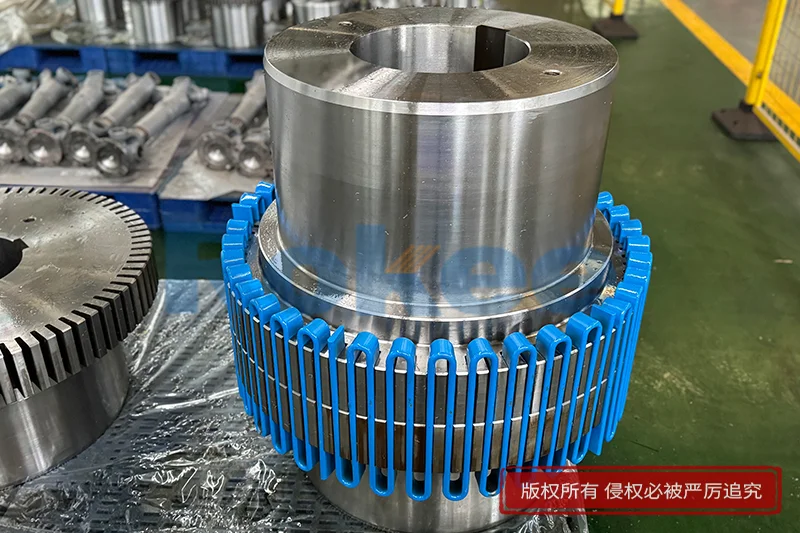
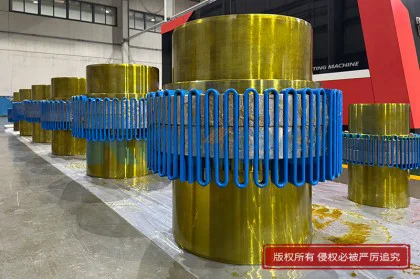
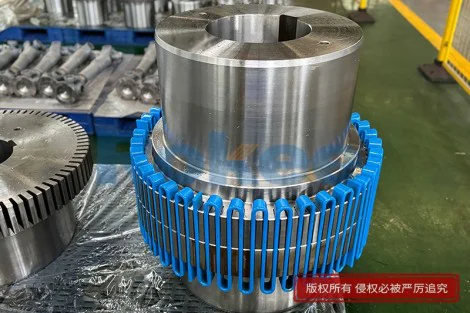
A serpentine spring flexible coupling is a mechanical power transmission device designed to connect two rotating shafts while accommodating misalignment, absorbing shock, and damping vibration. At its core, the coupling consists of two hubs with curved teeth around their outer rims and a serpentine-shaped spring that nests between those teeth, transmitting torque through the spring rather than through rigid metal-to-metal contact. This arrangement gives the coupling its name, as the spring undulates in a wave-like pattern along the circumference, engaging teeth on both sides simultaneously. The concept emerged from the need to protect driven equipment from the harsh torsional fluctuations common in reciprocating compressors, punch presses, and other impulse-loaded machinery. Unlike rigid couplings that demand near-perfect alignment, this type of coupling tolerates angular, parallel, and axial misalignment simultaneously, which makes it especially valuable in real-world installations where perfect alignment is difficult to achieve and maintain. The spring itself is typically made from high-quality alloy steel, heat-treated to balance toughness with fatigue resistance. Its curved geometry distributes contact forces across multiple teeth rather than concentrating stress on a single point, which contributes to long service life under demanding conditions. The entire assembly is often enclosed in a cover filled with lubricant, reducing friction and wear between the spring and the tooth surfaces. This combination of flexibility, damping, and torque capacity has made the serpentine spring coupling a staple in industries ranging from oil and gas to pulp and paper, marine propulsion, and material handling.
The operating principle of a serpentine spring flexible coupling relies on the controlled deformation of the spring as it transmits torque from the driving hub to the driven hub. When torque is applied, the spring compresses against the tooth flanks on the driving side and bears against the corresponding flanks on the driven side, bridging the gap between the two hubs. Because the spring is not rigid, it can flex and bend as the shafts rotate, allowing relative movement between the hubs while still transferring rotational force. Under light loads, the spring may engage only a few teeth near the center of the wave, but as torque increases, more teeth come into contact, distributing the load across a larger area. This progressive engagement means the coupling behaves softly under small disturbances and stiffens naturally as demand rises, providing built-in torsional flexibility that can protect both the driver and the driven machine. The spring's shape, with its alternating curves and straight sections, creates a spring rate that engineers can tune by altering wire diameter, number of waves, and overall length. Misalignment between the two shafts causes the spring to slide and bend slightly as the hubs rotate, rather than forcing the shafts themselves to bend or bind. This sliding action generates small frictional losses, which is why lubrication is critical; a well-lubricated coupling runs cooler and lasts far longer than one operating dry. The damping effect arises partly from material hysteresis in the spring and partly from the viscous drag of the lubricant film between the spring and teeth, which helps suppress resonant torsional vibrations that could otherwise damage equipment.
One of the defining advantages of a serpentine spring flexible coupling is its ability to handle significant misalignment without suffering rapid wear. In ideal theoretical installations, shafts can be aligned to within a few thousandths of an inch, but in practice, thermal expansion, foundation settling, bearing wear, and manufacturing tolerances all introduce small deviations that grow over time. This coupling tolerates angular misalignment where the two shaft axes intersect at a slight angle, parallel misalignment where the axes remain offset but parallel, and axial movement where one shaft slides in and out along its own axis. The spring bridges these offsets by flexing and redistributing its contact pattern, so the machinery continues to run smoothly even when alignment drifts. Because the spring contacts multiple teeth simultaneously, the load is shared rather than concentrated, which means the coupling does not suffer the same brinelling or pitting problems that plague rigid or jaw-type couplings under misaligned conditions. This tolerance extends the time between required realignments and reduces the likelihood of premature bearing failure, seal leakage, or gear damage on connected equipment. In installations where frequent disconnection is needed, such as pump drives or conveyor systems, the cover can be removed and the spring extracted without moving either hub, simplifying inspection and maintenance. The coupling also performs well in environments where slight axial float is unavoidable, such as in motor-driven pumps where thermal expansion causes the shaft to move axially during warm-up.
Shock absorption and vibration damping are among the most important reasons engineers select a serpentine spring flexible coupling for heavy-duty applications. Reciprocating compressors, diesel-engine-driven generators, rock crushers, and punch presses all deliver torque in pulses rather than smoothly, creating torsional spikes that travel through the driveline and can fatigue shafts, damage keys, and loosen bolted joints. The serpentine spring acts as a mechanical buffer: when a shock load arrives, the spring compresses and stores a portion of the energy, then releases it gradually as the wave settles. This flattening of the torque curve protects the driven equipment from instantaneous overload and smooths the rotational velocity seen at the output side. The coupling also shifts the natural torsional frequency of the driveline away from the operating speed range, helping to avoid resonance that could build up destructive vibration amplitudes. Because the spring is made of steel, it can absorb far more energy per unit volume than elastomeric elements, which makes it suitable for high-power shafts where rubber or plastic inserts would quickly degrade under heat and centrifugal force. At the same time, the sliding motion between the spring and the tooth flanks creates internal friction that dissipates vibrational energy as heat, further damping oscillations. This combination of resilience and hysteresis means the coupling can be used in equipment that runs continuously for long periods without wearing out, provided it is properly lubricated and aligned within its rated envelope.
Torque transmission capacity in a serpentine spring flexible coupling depends on several interrelated design factors, including the cross-sectional area of the spring wire, the number of waves engaged, the materials used, and the coefficient of friction at the contact surfaces. The spring carries torque by acting as a series of curved beams that bear against the teeth on both hubs, and because each tooth shares the load with its neighbors, the effective contact area is large relative to the coupling's overall size. This makes the coupling compact for its power rating, which is valuable in installations where space is limited. Engineers can select a larger or smaller spring cross-section to match the torque requirements of a given application, while the hub teeth are designed to withstand the resulting contact stresses without yielding or pitting. The surface finish of the teeth and the type of lubricant used also influence how much torque the coupling can transmit before wear becomes significant. In high-torque, low-speed applications such as mill drives or conveyor head shafts, the coupling operates with substantial tooth contact pressure, requiring a lubricant with extreme-pressure additives to prevent metal-to-metal scuffing. In high-speed applications, centrifugal force presses the spring outward against the inner wall of the cover, and the lubricant must remain in place and maintain its film strength under the resulting conditions. The coupling's torque rating is typically specified with a service factor that accounts for the nature of the load, with impulse-driven machinery requiring a higher factor than smoothly loaded equipment such as centrifugal pumps. This means two identical couplings can have very different expected lives depending on the duty cycle they serve, and proper application engineering is essential to avoid premature failure.
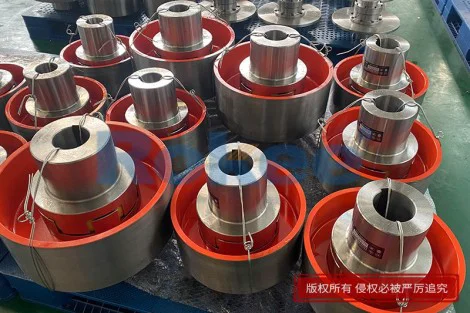
The materials and construction details of a serpentine spring flexible coupling play a critical role in its durability and performance. Hubs are usually forged or cast from alloy steel, ductile iron, or sometimes stainless steel for corrosion-resistant environments, and their teeth are precisely machined to a curved profile that matches the spring's wave geometry. The teeth are heat-treated or surface-hardened to resist wear, and in many designs they are replaceable as wear parts, allowing the hubs to be rebuilt rather than replaced outright. The spring itself is formed from high-strength alloy steel wire, often through a cold-winding process that creates the characteristic serpentine shape, then heat-treated to achieve a balance between hardness and toughness. Too hard and the spring becomes brittle, susceptible to cracking under shock; too soft and it deforms permanently under sustained torque. The ends of the spring are typically squared or hooked to locate it within the cover and prevent axial migration during operation. The cover, which encloses the spring and retains the lubricant, is usually made from cast iron or aluminum and fitted with gaskets and sealing elements to keep oil in and contaminants out. On larger units, the cover may include inspection plugs and grease fittings for periodic relubrication without disassembly. The bolt pattern and shaft bore sizes are matched to the equipment flanges and journals, and keyways or interference fits transmit torque between the hub and the shaft. In corrosive environments such as coastal facilities or chemical plants, protective coatings and stainless variants can extend the service life of the assembly, though they may come at the cost of reduced torque capacity or higher installed weight.
Lubrication is arguably the most important maintenance factor for a serpentine spring flexible coupling, because the sliding contact between the spring and the tooth flanks would quickly generate heat and wear if left unlubricated. The cover is designed as a sealed bath or sump that holds a specified volume of oil or grease, creating a film that separates the steel surfaces and carries away frictional heat. Under operation, the spring rotates and churns the lubricant, distributing it across the engaged teeth and ensuring that all contact points receive adequate film thickness. The choice between oil and grease depends on speed, temperature, and ambient conditions: oil provides better cooling and more uniform distribution, while grease is simpler to retain and better suited to lower speeds or vertical shaft arrangements. Extreme-pressure lubricants containing sulfur-phosphorus additives are commonly used because they form chemical boundary films on the tooth surfaces, protecting them from scuffing under high contact pressures. Over time, the lubricant degrades from heat, oxidation, and contamination by moisture or abrasive dust, which is why manufacturers recommend periodic oil analysis or scheduled replacement intervals. Under-lubrication leads to rapid wear, overheating, and eventual spring breakage, while over-lubrication can cause churning losses and overheating as well. Seal integrity is equally important: worn gaskets or cracked covers allow lubricant to escape and dirt to enter, accelerating wear. Proper installation practice includes filling the cover to the correct level, checking seals after a short break-in run, and establishing a routine inspection schedule based on operating hours rather than calendar time alone.
Installation and alignment procedures for a serpentine spring flexible coupling follow a sequence that protects both the coupling and the connected equipment from avoidable damage. Before mounting, the shafts, hubs, and mating surfaces are inspected for burrs, rust, and damage, and the bore sizes are checked against the shaft journals to ensure proper fits. The hubs are typically heated or pressed onto the shafts, with keyways aligned and set screws tightened to the recommended torque values. Once both hubs are in place, the driving and driven machines are positioned so that the gap between the hub faces matches the manufacturer's specified spacer dimension, leaving room for the spring and accommodating axial movement. Alignment is then performed using dial indicators or laser alignment tools, bringing the angular and parallel offsets within the coupling's allowable misalignment envelope. Although the coupling tolerates misalignment, running beyond those limits concentrates wear on a small number of teeth and shortens service life, so careful initial alignment is still essential. The serpentine spring is then inserted between the teeth, taking care not to force it or damage the wave ends, and the cover is installed with fresh gaskets. The lubricant is added to the prescribed level, and the coupling is rotated by hand to confirm that it turns freely without binding. During the initial run-in, the unit is monitored for unusual noise, vibration, or temperature rise, and the alignment is rechecked after the machinery has reached operating temperature, since thermal growth can shift the relative positions of the machines. Once commissioned, the coupling requires minimal attention, but periodic alignment checks and lubricant analysis help catch drift before it becomes a failure.
Maintenance and troubleshooting of a serpentine spring flexible coupling focus on monitoring wear, lubrication condition, and alignment drift over time. Routine inspections typically involve checking the cover for oil leaks, measuring the coupling exterior temperature with a contact pyrometer or infrared gun, and listening for unusual noises that indicate dry running or tooth damage. When the cover is removed for scheduled lubricant changes, the spring and teeth are examined for signs of pitting, scoring, fretting, or fatigue cracks. A worn spring may show reduced wave height or flattened contact patches, and if cracks are visible, the spring should be replaced immediately rather than waiting for the next scheduled outage. Tooth wear is measured by checking the clearance between the spring and the tooth flanks; excessive play indicates that the contact surfaces have worn beyond their service limit and the hubs may need to be rebuilt or replaced. Common operational problems include overheating, which usually stems from overfilling the lubricant, excessive misalignment, or a degraded lubricant that has lost its film strength; vibration, which can indicate a broken spring, worn bearings, or a driveline resonance issue; and noise, which often signals inadequate lubrication or the ingress of abrasives into the cover. When a failure does occur, the cause is investigated rather than simply replacing the part, because root causes such as soft foot on the motor, misaligned foundations, or torsional resonance will destroy the new coupling as well. Keeping records of oil changes, alignment readings, and vibration trends allows maintenance teams to predict wear and plan replacements during planned outages, avoiding unplanned shutdowns that can be costly in continuous-process industries.
The versatility and long service history of the serpentine spring flexible coupling continue to make it a relevant choice in modern power transmission design, even as newer coupling types enter the market. Its steel spring construction offers a unique combination of high torque capacity, moderate flexibility, and tolerance for harsh operating conditions that elastomeric couplings often cannot match, especially in high-temperature, high-power, or corrosive environments. It is widely used in centrifugal and reciprocating pumps, compressors, blowers, fans, conveyors, mixers, pulp refiners, rolling mills, and marine propulsion systems, wherever shafts must be connected without rigid alignment and where shock or vibration is present. Compared with gear couplings, the serpentine spring design has simpler internal components, does not require gear mesh precision, and tolerates misalignment more gracefully; compared with disc or diaphragm couplings, it is more forgiving of impulse loads and generally less sensitive to small installation errors. At the same time, it has limitations: it is not suitable for extremely high misalignment, it requires regular lubrication, and its torsional stiffness is not as precisely controllable as that of metallic membrane couplings. Engineers evaluating a coupling for a new application weigh these factors against the specific duty cycle, space envelope, maintenance philosophy, and cost targets. As industries demand longer runs between maintenance intervals and more precise torsional tuning, manufacturers continue to refine tooth profiles, spring materials, seal designs, and lubrication chemistry, extending the coupling's reach into new applications. The enduring appeal of the serpentine spring flexible coupling lies in its simplicity: a single spring, two toothed hubs, and a lubricated cover, working together to transmit power smoothly in some of the most demanding mechanical environments on earth.