Membrane Coupling Empowers Phenolic Insulation Board Production Line To Improve Quality And Efficiency
In the modern construction industry, energy conservation and environmental protection have become core drivers of technological innovation and industrial upgrading, and phenolic insulation boards have emerged as essential materials due to their excellent flame retardancy, thermal insulation performance, low smoke toxicity, and durability. These boards are widely used in various construction scenarios, including exterior wall insulation, subway tunnels, and industrial workshops, where their quality and performance directly affect the safety, energy efficiency, and service life of buildings. The phenolic insulation board production line, as the core equipment for mass production of these high-performance materials, integrates multiple technological processes such as raw material preparation, mixing, foaming, molding, curing, and cutting. The stability, precision, and efficiency of the production line are crucial to ensuring the consistency of product quality, reducing production costs, and meeting the growing market demand. In recent years, with the continuous improvement of industrial automation and the increasing requirements for product quality, membrane couplings have gradually replaced traditional coupling devices in phenolic insulation board production lines, becoming a key component that empowers the production line to achieve quality improvement and efficiency enhancement.
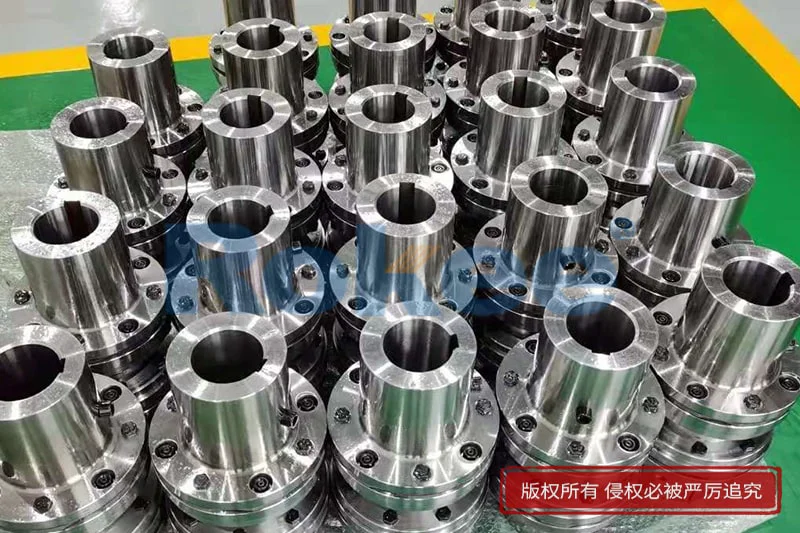
A membrane coupling is a high-performance flexible coupling that uses metal elastic elements to achieve power transmission and deviation compensation, representing the advanced level of modern coupling technology. Unlike traditional couplings that rely on rigid connections or elastic components such as rubber, membrane couplings utilize the elastic deformation ability of a diaphragm group composed of multiple layers of ultra-thin high-strength stainless steel sheets to transmit torque and compensate for misalignments between connected shafts. The basic structure of a membrane coupling mainly includes two shaft sleeves (or half-couplings) installed on the driving shaft and the driven shaft respectively, and a diaphragm group that connects these two shaft sleeves. The diaphragm group is usually composed of 4 to 12 layers of precision-machined stainless steel thin plates, which are equipped with bolt holes and special stress relief grooves to ensure uniform torque transmission and reduce stress concentration. According to different design requirements, the diaphragm can be divided into linkage type and integral type: the linkage type is connected to the inner and outer rings through multiple separate connecting rod arms, providing better flexibility, while the integral type adopts a continuous integral ring structure, offering higher torsional stiffness. Both types can be tailored to the specific needs of different production scenarios, ensuring stable and efficient power transmission.
The working principle of membrane couplings is based on the theory of metal elastic deformation. When the driving shaft rotates, torque is transmitted to the diaphragm group through bolt connections, and the diaphragm undergoes slight elastic deformation under the action of torque, thereby transmitting the rotational motion to the driven shaft. During this process, if there are axial, radial, or angular deviations between the two shafts—caused by factors such as equipment installation errors, thermal expansion during operation, or mechanical vibration—the diaphragm can absorb these deviations through its flexible deformation, avoiding stress concentration and equipment damage that may occur due to rigid connections. It is worth noting that the deformation of the diaphragm is inversely proportional to its thickness, so accurate calculation of the diaphragm thickness during design is essential to achieve an ideal balance between stiffness and compensation capability. This unique working mechanism enables membrane couplings to maintain high transmission precision even in complex working conditions, which is particularly important for phenolic insulation board production lines that require stable and precise operation of multiple process links.
The phenolic insulation board production line is a systematic equipment combination that involves multiple sequential processes, each of which has strict requirements for power transmission stability and precision. The raw material preparation system, including phenol formaldehyde reaction kettles and pH adjustment devices, needs stable power transmission to ensure uniform mixing of raw materials and accurate control of reaction conditions. The pre-mixed foaming section relies on high-speed stirring equipment to mix foaming agents with phenolic resin evenly, and any instability in power transmission will lead to uneven foaming, affecting the density and thermal insulation performance of the final product. The compression molding machine and post-curing chamber require precise control of pressure and temperature gradients, and the stability of the transmission system directly determines the consistency of the board's thickness, flatness, and mechanical properties. The surface treatment line, including sanding machines and interface agent coating equipment, also needs stable power to ensure smooth and uniform surface treatment of the boards. Traditional couplings, such as gear couplings or rubber couplings, have inherent drawbacks in these scenarios: gear couplings require regular lubrication, are prone to wear and tear, and have poor deviation compensation capabilities, leading to unstable transmission and frequent maintenance; rubber couplings have limited temperature resistance and are easy to age and deform under the high-temperature environment of the curing process, resulting in reduced transmission precision and shortened service life. These problems often lead to fluctuations in product quality, increased equipment downtime, and reduced production efficiency, which are difficult to meet the high-quality production requirements of phenolic insulation boards.
Membrane couplings effectively solve the above problems with their unique structural and performance advantages, bringing significant improvements to the quality and efficiency of phenolic insulation board production lines. One of the most prominent advantages is their high transmission precision and zero rotational clearance. Membrane couplings have a transmission efficiency of up to 99.86%, and the seamless connection between the diaphragm group and the shaft sleeves ensures zero backlash during power transmission, avoiding speed slip and torque fluctuations. In the raw material mixing process, this high precision ensures that the stirring equipment maintains a stable rotation speed, enabling uniform mixing of phenolic resin, foaming agents, curing agents, and other raw materials. Uniform raw material mixing is the foundation for stable foaming and curing of phenolic insulation boards, as it prevents the occurrence of local uneven density, bubbles, or cracks in the boards. In the compression molding process, stable power transmission ensures that the pressure applied to the board is uniform and consistent, avoiding uneven thickness or deformation caused by pressure fluctuations. The post-curing chamber requires precise control of temperature gradients, and the stable operation of the transmission system ensures that the conveyor belt runs at a constant speed, allowing the boards to be heated evenly during the curing process, thereby improving the mechanical strength and flame retardancy of the products. Statistics show that after adopting membrane couplings, the qualification rate of phenolic insulation boards can be increased by 8% to 12%, significantly reducing the waste of raw materials and production costs.
Another key advantage of membrane couplings is their excellent deviation compensation capability, which adapts to the complex working environment of phenolic insulation board production lines. During the operation of the production line, factors such as mechanical vibration, thermal expansion of equipment components, and slight foundation settlement will cause axial, radial, or angular deviations between the driving shaft and the driven shaft. Traditional couplings are difficult to effectively compensate for these deviations, which will lead to increased wear of equipment components, increased noise, and even equipment failure. Membrane couplings, through the elastic deformation of the diaphragm group, can effectively absorb these deviations: radial displacement causes the diaphragm to undergo tensile or compressive deformation, angular displacement causes bending deformation, and axial displacement causes planar deformation. This deviation compensation capability not only reduces the wear of bearings, shafts, and other components, extending the service life of the equipment, but also ensures the stable operation of the entire production line, reducing the frequency of equipment downtime. For example, in the foaming and molding process, the vibration generated by the high-speed operation of the stirring equipment and the molding machine can be effectively absorbed by the membrane coupling, avoiding the impact of vibration on the foaming uniformity and molding precision of the boards. In addition, the deviation compensation capability of membrane couplings also reduces the requirements for equipment installation precision, reducing the difficulty and cost of installation and maintenance.
The high temperature resistance and corrosion resistance of membrane couplings also make them highly suitable for the working environment of phenolic insulation board production lines. The post-curing process of phenolic insulation boards usually requires heating at 120-150℃, and some high-end production lines even use a two-stage curing process, with pre-curing at 60-80℃ followed by high-temperature curing. Traditional rubber couplings are easy to age, soften, and deform under high-temperature conditions, leading to reduced transmission performance and shortened service life. Membrane couplings, made of high-strength stainless steel, have excellent high-temperature resistance, with a normal working temperature range of -80℃ to +300℃, and can even reach -196℃ to +350℃ with special materials. This enables membrane couplings to maintain stable performance in the high-temperature environment of the curing chamber, without aging or deformation, ensuring long-term stable operation of the production line. In addition, the production process of phenolic insulation boards involves the use of various chemical raw materials, which may produce corrosive gases or liquids. The stainless steel diaphragm of the membrane coupling has good corrosion resistance, being resistant to acids, alkalis, oils, and other corrosive media, avoiding corrosion damage and ensuring the reliability of power transmission. This corrosion resistance also reduces the frequency of coupling replacement, reducing maintenance costs and equipment downtime.
The maintenance-free characteristic of membrane couplings further improves the efficiency of the phenolic insulation board production line. Traditional gear couplings require regular lubrication and maintenance to prevent wear and tear, which not only increases labor costs but also requires stopping the production line during maintenance, affecting production efficiency. Membrane couplings have a simple structure, no sliding parts, and do not require lubrication, thus achieving maintenance-free operation. The diaphragm group is made of high-strength stainless steel with excellent wear resistance and fatigue resistance, and its service life is much longer than that of traditional coupling components. Even if the diaphragm needs to be replaced after long-term use, the replacement process is simple and quick, without the need for complex disassembly of the equipment, which can be completed in a short time, minimizing the impact on production. This maintenance-free characteristic not only reduces the labor intensity of maintenance personnel but also reduces the downtime of the production line, improving the overall production efficiency. It is estimated that the use of membrane couplings can reduce equipment maintenance time by 30% to 40%, and increase the effective operation time of the production line by 5% to 8%.
In addition to improving product quality and production efficiency, membrane couplings also contribute to energy conservation and environmental protection of the phenolic insulation board production line. The high transmission efficiency of membrane couplings reduces energy loss during power transmission. Compared with traditional couplings, which have transmission efficiency of around 95% to 97%, membrane couplings with a transmission efficiency of up to 99.86% can save a significant amount of electrical energy in long-term continuous operation. For large-scale phenolic insulation board production lines with high power consumption, this energy-saving effect is particularly obvious, which not only reduces production costs but also conforms to the concept of green production. In addition, the maintenance-free characteristic of membrane couplings reduces the use of lubricating oils, avoiding environmental pollution caused by lubricating oil leakage. The stainless steel material used in membrane couplings is recyclable, which is in line with the requirements of circular economy and environmental protection. With the increasing emphasis on global energy conservation and environmental protection policies, the application of membrane couplings helps phenolic insulation board production enterprises achieve green production, enhance their market competitiveness.
The application of membrane couplings in phenolic insulation board production lines also brings significant economic benefits to enterprises. On the one hand, the improvement of product qualification rate reduces the waste of raw materials and the cost of rework, directly reducing production costs. On the other hand, the increase in production efficiency and the reduction in equipment downtime enable enterprises to produce more high-quality products in the same time, expanding market supply and increasing sales revenue. The reduction in maintenance costs and the extension of equipment service life also further reduce the overall operating costs of enterprises. For example, a medium-sized phenolic insulation board production enterprise that adopts membrane couplings can save hundreds of thousands of yuan in raw material waste, maintenance costs, and energy consumption every year, while the qualification rate of products is significantly improved, enhancing the enterprise's brand reputation and market influence. In the long run, the investment in membrane couplings can bring considerable return on investment for enterprises, promoting the sustainable development of enterprises.
It should be noted that to maximize the role of membrane couplings in phenolic insulation board production lines, enterprises need to select the appropriate type and specification of membrane couplings according to the actual working conditions of the production line. Factors such as the power of the equipment, the speed of the shaft, the magnitude of torque, the type and range of deviation, and the working temperature should be fully considered during the selection process. For example, in the high-speed stirring section of the production line, which requires high transmission precision and small deviation, integral membrane couplings with high torsional stiffness can be selected; in the section with large installation deviation or severe vibration, double membrane couplings with strong deviation compensation capability can be selected. In addition, correct installation and debugging are also essential to ensure the performance of membrane couplings. During installation, the coaxiality of the driving shaft and the driven shaft should be adjusted as much as possible, and the bolts should be tightened according to the specified torque to avoid loose connections affecting transmission precision. Regular inspection of the diaphragm group for damage, deformation, or fatigue cracks is also necessary, and timely replacement should be made if any problems are found to ensure the stable operation of the production line.
With the continuous development of the phenolic insulation board industry and the increasing requirements for product quality and production efficiency, the application of membrane couplings in production lines will become more widespread. In the future, with the advancement of material science and manufacturing technology, membrane couplings will be further optimized in terms of structure, material, and performance. For example, the development of new high-strength, lightweight diaphragm materials will further improve the transmission efficiency and service life of membrane couplings; the integration of intelligent monitoring technology will enable real-time monitoring of the operating status of membrane couplings, realizing predictive maintenance and further reducing equipment downtime. These improvements will make membrane couplings play a more important role in the upgrading and development of phenolic insulation board production lines, helping enterprises achieve higher quality, more efficient, and greener production.
In conclusion, membrane couplings, with their high transmission precision, excellent deviation compensation capability, high temperature and corrosion resistance, and maintenance-free characteristics, have become an important component that empowers phenolic insulation board production lines to improve quality and efficiency. They effectively solve the problems of unstable transmission, low precision, high maintenance costs, and short service life of traditional couplings, ensuring the stability and consistency of product quality, improving production efficiency, reducing production costs, and bringing significant economic and environmental benefits to enterprises. As the phenolic insulation board industry continues to develop, the application of membrane couplings will become more in-depth and widespread, promoting the sustainable development of the entire industry towards high quality, high efficiency, and green environmental protection.