Diaphragm Coupling Optimizes Transmission Efficiency Of Insulation Panel Production Line
In the modern construction industry, energy conservation and environmental protection have become core drivers of technological innovation and industrial upgrading, and insulation panels have emerged as indispensable materials for improving building energy efficiency, thermal insulation, and sound insulation performance. These panels, widely applied in residential buildings, commercial complexes, industrial workshops, and cold storage facilities, rely heavily on efficient and stable production lines to meet the growing market demand. An insulation panel production line is a complex integrated system that integrates multiple processes, including raw material feeding, mixing, molding, curing, cutting, and conveying. Each link requires precise power transmission to ensure consistent product quality and continuous production efficiency. Among the numerous components that constitute the production line’s transmission system, the diaphragm coupling stands out as a key element that significantly optimizes transmission efficiency, solves long-standing operational pain points, and promotes the upgrading of the insulation panel manufacturing industry.
To understand how diaphragm couplings optimize the transmission efficiency of insulation panel production lines, it is first necessary to clarify the working characteristics of these production lines and the core challenges faced by their transmission systems. Modern insulation panel production lines are developing towards automation, intelligence, and continuity, with production processes that require the coordinated operation of multiple subsystems—such as the raw material feeding system, mixing system, molding system, curing system, cutting system, and conveying system. Each subsystem is driven by an independent power source, and power needs to be transmitted to various executive components accurately and stably to ensure that the entire production line operates in a synchronized manner. However, in practical operation, the transmission system often faces several key challenges that restrict efficiency. Firstly, due to the limitations of the production process and equipment layout, the driving shafts and driven shafts of different subsystems are often not coaxial, resulting in angular, radial, and axial displacements between the shafts. Secondly, during long-term continuous operation, the production line generates vibration and thermal expansion, which further exacerbates shaft misalignment and affects transmission stability. Thirdly, the insulation panel production process requires variable speed operation in some links—such as adjusting the feeding speed according to raw material viscosity or changing the cutting speed based on panel thickness—which demands that the transmission component have excellent speed adjustment performance and torque stability. Fourthly, traditional transmission components such as gear couplings require regular lubrication and maintenance, which not only increases operational costs but also leads to production interruptions during maintenance, affecting overall production efficiency. These challenges have become bottlenecks restricting the efficient operation of insulation panel production lines, and there is an urgent need for a high-performance transmission component to solve these problems.
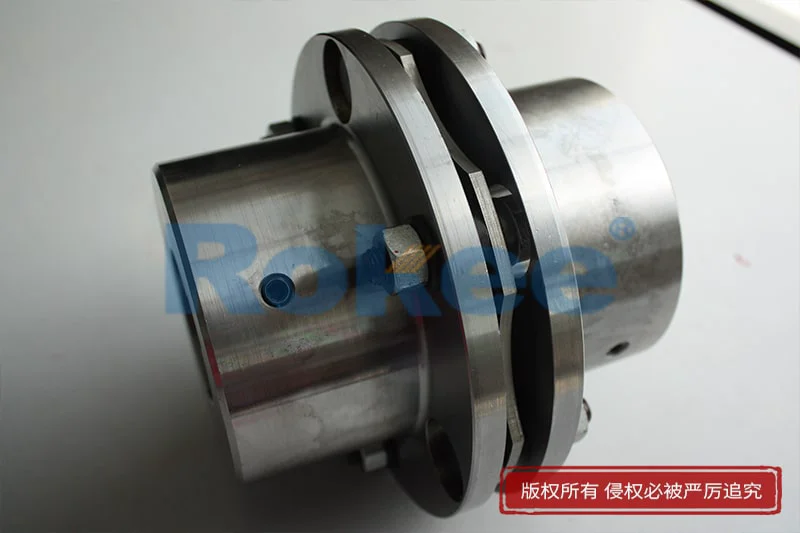
The diaphragm coupling, as a high-performance metal elastic flexible coupling, has gradually become the preferred transmission component for insulation panel production lines due to its unique structural design and excellent performance characteristics. Unlike traditional couplings, the diaphragm coupling is composed of a diaphragm group made of multiple layers of stacked stainless steel thin plates, which are connected to the two halves of the coupling through staggered bolts. Its core working principle is to compensate for axial, radial, and angular displacements between two shafts through the elastic deformation of the diaphragm, thereby achieving efficient power transmission without the need for lubrication. This structural design not only addresses the problem of shaft misalignment in insulation panel production lines but also eliminates many drawbacks of traditional couplings, providing reliable support for the efficient operation of the production line.
One of the key ways diaphragm couplings optimize the transmission efficiency of insulation panel production line is through their high-precision transmission performance. The insulation panel production process has strict requirements for the synchronization and stability of each link—for example, the mixing system needs to maintain a stable speed to ensure uniform mixing of raw materials, the molding system requires precise power transmission to control the thickness and flatness of the panel, and the cutting system must achieve accurate cutting to avoid material waste and product defects. The diaphragm coupling adopts a zero-rotation clearance design, which ensures that there is no relative slip during power transmission, and its transmission efficiency can reach up to 99.86%, significantly higher than that of traditional gear couplings and elastic pin couplings. This high-precision transmission ensures that the power output of each subsystem is accurately transmitted to the executive components, avoiding errors caused by transmission lag or slippage, thereby improving the consistency of product quality and reducing the rejection rate. In the mixing link, for example, the stable power transmission of the diaphragm coupling ensures that the mixing shaft rotates at a constant speed, making the raw materials such as cement, sand, mineral wool, and polyurethane foam mix uniformly, which directly affects the thermal insulation performance and structural stability of the final insulation panel. In the cutting link, the precise transmission of the diaphragm coupling enables the cutting blade to operate at a stable speed, ensuring that the insulation panel is cut to the required dimensions with a tolerance of ±0.5mm, reducing material waste and improving production efficiency.
Another important advantage of diaphragm couplings in optimizing transmission efficiency is their strong ability to compensate for shaft misalignment. As mentioned earlier, due to the complex layout of insulation panel production lines, shaft misalignment is inevitable between different subsystems. Traditional couplings such as gear couplings have limited misalignment compensation capabilities, and long-term operation under misalignment conditions will lead to increased wear, reduced transmission efficiency, and even component damage. In contrast, the diaphragm coupling can compensate for multi-directional displacements through the elastic deformation of the stainless steel diaphragm. Single-diaphragm couplings are suitable for scenarios with small misalignments, while double-diaphragm couplings, by adding an intermediate rigid element, can simultaneously handle angular, radial, and axial displacements, with an angular displacement compensation capability twice that of traditional gear couplings (up to 1.5°). This strong compensation capability allows the diaphragm coupling to adapt to the working environment of insulation panel production lines, reducing the impact of shaft misalignment on transmission efficiency and equipment life. For example, in the conveying system of the production line, the conveyor belt’s driving shaft and the motor shaft often have a certain angular deviation due to installation errors. The diaphragm coupling can effectively compensate for this deviation through the elastic deformation of the diaphragm, ensuring that the conveyor belt operates stably at a constant speed, avoiding material jams or uneven conveying caused by unstable transmission, and thus improving the continuity of the production line.
The maintenance-free and long-service-life characteristics of diaphragm couplings also play a crucial role in optimizing the transmission efficiency of insulation panel production lines. Traditional couplings such as gear couplings require regular lubrication and maintenance—adding lubricating oil, checking for wear, and replacing worn components—which not only consumes a lot of manpower and material resources but also requires stopping the production line during maintenance, leading to production interruptions. In contrast, the diaphragm coupling has a simple structure, no sliding parts, and does not require lubrication. The stainless steel diaphragm has excellent wear resistance, corrosion resistance, and fatigue resistance, and can operate stably for a long time under harsh working conditions. The service life of the diaphragm coupling is usually several times that of traditional couplings, and regular inspection only needs to check for fatigue cracks in the diaphragm (it is recommended to stop the machine for inspection every 5000 hours), which is simple and fast and does not require long-term production interruption. For insulation panel production lines that pursue continuous operation, this maintenance-free feature can significantly reduce downtime, improve equipment utilization, and reduce operational costs. For example, a medium-sized insulation panel factory that adopts diaphragm couplings can reduce maintenance time by more than 80% compared to using traditional gear couplings, and the annual maintenance cost can be reduced by 30% to 50%, while the production efficiency can be increased by 15% to 20% due to reduced downtime.
In addition, the excellent environmental adaptability and vibration absorption performance of diaphragm couplings further optimize the transmission efficiency of insulation panel production lines. Insulation panel production lines often operate in harsh environments—some production links involve high temperatures (such as the curing process, where the temperature can reach 150°C or higher), while others may generate corrosive gases or dust (such as the mixing of chemical raw materials). The diaphragm coupling is made of high-strength stainless steel, which has a wide temperature resistance range (-80°C to +300°C), and can operate stably in corrosive media such as acids and alkalis, without being affected by temperature changes or environmental pollution. At the same time, the metal diaphragm of the diaphragm coupling can absorb vibration generated during the operation of the production line, reduce the load on the bearing, and reduce the operating noise to below 65dB(A). This vibration absorption performance not only protects the transmission system and other equipment components from damage but also ensures the stable operation of the production line. For example, in the molding process of insulation panels, the vibration generated by the molding machine will be transmitted to the transmission system. The diaphragm coupling can absorb most of the vibration, avoiding the loosening of bolts or damage to components caused by vibration, ensuring the stable operation of the molding system, and improving the quality of the insulation panel.
The application of diaphragm couplings also helps to optimize the energy efficiency of insulation panel production lines, which is in line with the global trend of energy conservation and environmental protection. The high transmission efficiency of diaphragm couplings means that less energy is lost during power transmission, which can effectively reduce the energy consumption of the production line. Compared with traditional gear couplings, which have transmission efficiency of around 95% to 97%, the diaphragm coupling’s transmission efficiency of up to 99.86% can save a lot of energy for the production line in long-term operation. For example, a large insulation panel production line with a daily output of 10,000 square meters can save more than 500 kWh of electricity per day by using diaphragm couplings, which not only reduces the production cost of the enterprise but also contributes to environmental protection. In addition, the lightweight and compact structure of the diaphragm coupling reduces the load on the motor, further improving energy efficiency. The diaphragm coupling’s weight is usually 30% to 50% lighter than that of traditional gear couplings of the same specification, which reduces the energy consumption of the motor during operation and extends the service life of the motor.
To better play the role of diaphragm couplings in optimizing the transmission efficiency of insulation panel production lines, reasonable selection and correct installation are crucial. In the selection process, enterprises should consider the specific working conditions of the production line, such as the transmission power, speed, shaft diameter, and misalignment amount, to select the appropriate type of diaphragm coupling (single-diaphragm or double-diaphragm) and specifications. For example, in the high-speed mixing system and cutting system of the production line, which require high transmission precision and small misalignment, single-diaphragm couplings can be selected; in the conveying system and molding system, which have large misalignment, double-diaphragm couplings with stronger compensation capabilities are more suitable. In the installation process, it is necessary to use a torque wrench to tighten the bolts in stages (first 50% of the rated torque, then 100%), ensuring a flange clearance of 0.2-0.3mm to avoid damage to the diaphragm due to excessive bolt torque. At the same time, when multiple deviations coexist, the compensation amount should be controlled at 50% of the allowable value to ensure the stable operation of the coupling. In addition, regular inspection and maintenance of the diaphragm coupling are also necessary—checking for fatigue cracks, deformation, or bolt loosening of the diaphragm, and replacing damaged diaphragms in a timely manner to avoid affecting the transmission efficiency and safety of the production line.
In recent years, with the continuous improvement of global energy conservation policies and the increasing demand for green buildings, the insulation panel industry has developed rapidly, and the requirements for production efficiency and product quality have become higher and higher. The application of diaphragm couplings in insulation panel production lines has gradually become widespread, bringing significant economic and social benefits to enterprises. By optimizing transmission efficiency, reducing maintenance costs, improving product quality, and saving energy, diaphragm couplings have become an important driving force for the upgrading of the insulation panel manufacturing industry. Many insulation panel manufacturers have achieved significant improvements in production efficiency and product quality after adopting diaphragm couplings, enhancing their market competitiveness.
Looking to the future, with the continuous development of industrial technology, diaphragm couplings will continue to be upgraded and improved. The application of new materials (such as carbon fiber composites) will further improve the performance of diaphragm couplings, making them more lightweight, high-strength, and corrosion-resistant. The integration of intelligent technology will enable diaphragm couplings to have real-time monitoring and fault early warning functions, which can timely detect potential problems such as diaphragm fatigue and bolt loosening, further reducing downtime and improving the reliability of the transmission system. At the same time, with the popularization of intelligent production lines, diaphragm couplings will be more closely integrated with intelligent control systems, realizing precise control of transmission speed and torque, and better adapting to the needs of flexible production of insulation panels.
In conclusion, the diaphragm coupling, with its high-precision transmission, strong misalignment compensation capability, maintenance-free feature, excellent environmental adaptability, and energy-saving performance, plays an irreplaceable role in optimizing the transmission efficiency of insulation panel production lines. It solves the key pain points faced by the transmission system of insulation panel production lines, improves production efficiency, reduces operational costs, ensures product quality, and promotes the sustainable development of the insulation panel industry. As the insulation panel industry continues to develop, the application of diaphragm couplings will become more widespread, and they will continue to inject new vitality into the efficient and green production of insulation panels.