Universal Shaft Cooperates With Continuous PU Sandwich Panel Production Line To Improve Production Flexibility

In modern manufacturing, continuous polyurethane sandwich panel production line has become the backbone of efficient, high-volume panel manufacturing for the building envelope, cold storage, and cleanroom industries. These integrated lines combine unwinding, lamination, foam injection, heating, curing, cutting, and stacking into one uninterrupted process, and their overall productivity depends on every sub-system moving in perfect synchronization. Among the many mechanical components that keep this synchronization intact, the universal shaft, also known as the universal joint drive shaft or cardan shaft, plays a quietly decisive role. By transmitting rotary motion between shafts that are not perfectly aligned—whether due to mounting tolerances, thermal expansion, vibration, or deliberate design offsets—the universal shaft allows different drive stations along the line to share power without the rigid constraints of a straight coupling. This capability is especially valuable on a continuous PU sandwich panel line, where the decoiler, glue station, double-band laminator, side-sealing rollers, edge trimming, and discharge conveyor each rotate at their own speeds and heights, yet must feed material into a single, unbroken web. When the universal shaft is properly selected and maintained, it absorbs angular misalignment, compensates for slight axial movement, and dampens torsional shock, all while maintaining constant torque transfer. The result is a drive train that tolerates the real-world imperfections of an industrial line rather than demanding perfect geometric idealism.
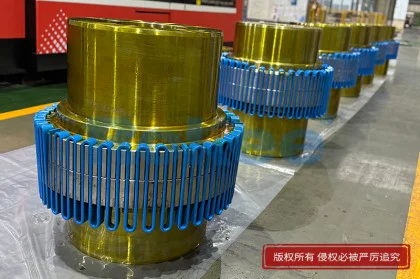
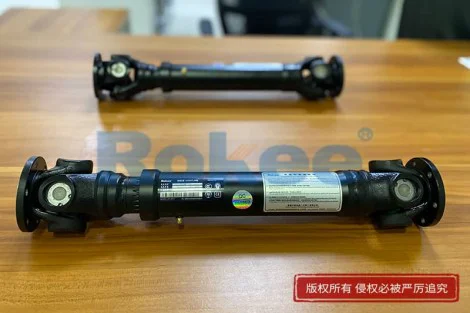
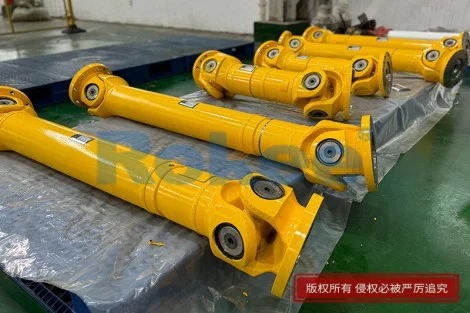
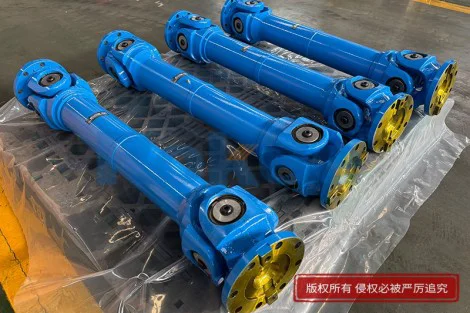
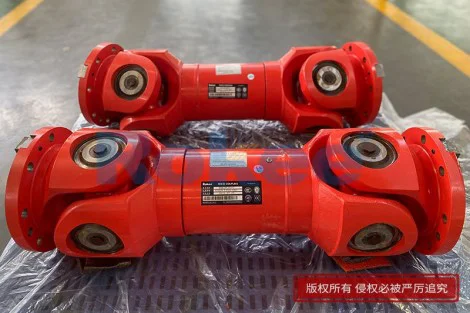
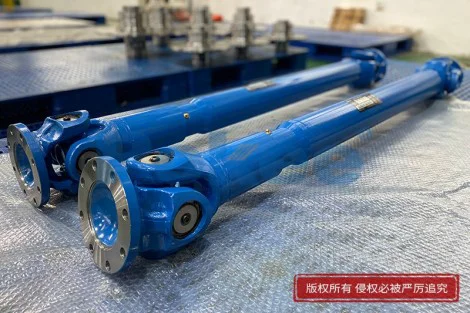
The structural design of a universal shaft is well suited to the harsh environment of a PU sandwich panel line. Typically comprising a pair of yokes, a cross bearing, needle rollers, seals, a telescopic splined or slip tube, and a connecting flange, the assembly can be built in a range of lengths, diameters, and angular capacities to match the torque curve of each station. On a continuous PU line, the laminator section is the most demanding: two endless steel belts travel at matched speeds while the polyurethane chemistry expands between the top and bottom metal skins. The rollers that guide these belts, the heater drums, and the main drive drums are often mounted in heavy frames that flex slightly under load and expand under heat. A rigid coupling would quickly suffer fretting wear, bolt loosening, or bearing fatigue, but the universal shaft flexes through its crossed yokes and accommodates the resulting angle. The slip tube, meanwhile, allows minute changes in center distance as the machine warms up or as the belt track is re-tensioned. This combination of angular and axial compliance is what makes the universal shaft so much more forgiving than fixed couplings in a long, thermally active production hall.
Beyond raw mechanical tolerance, the universal shaft contributes directly to the production flexibility that panel manufacturers increasingly demand. Today's customers order panels in a growing mix of thicknesses, widths, surface finishes, core densities, and lengths, and a line that can switch between recipes quickly has a clear commercial advantage. When a line runs, for example, from a 50-millimeter insulated wall panel to a 120-millimeter cold-room panel, the line speed, foam output, heater temperature, and belt pressure all change. The main drive must deliver different torque at the new speed, and the auxiliary rollers must reposition to the new panel thickness. Universal shafts, with their ability to transmit rated torque over a broad angular range, allow the drive motors and reducers to remain mounted in fixed, convenient positions while the driven rolls move vertically. The motor does not have to shift with the roll; the shaft simply bends through its universal joints. This decoupling of motor location from driven-roll location is what gives engineers the freedom to redesign stations for new panel formats without rebuilding the entire drive train. In effect, the universal shaft becomes a flexible mechanical interface between the "fixed" and the "moving" worlds of the line.
Misalignment compensation is not, however, an invitation to sloppy installation. Universal joints introduce secondary effects that must be understood if the line is to run smoothly. A single universal joint, when operating at an angle, does not transmit a perfectly constant angular velocity: the driven shaft accelerates and decelerates twice per revolution relative to the driving shaft. This speed ripple becomes more pronounced as the operating angle increases, and it can induce small torsional vibrations in the belt drive, which in turn may cause uneven belt tension, subtle surface marks on the finished panel, or noise in the drive train. The conventional remedy is to use paired universal joints in a so-called "double cardan" or constant-velocity arrangement, where the yokes are phased correctly so that the second joint cancels the velocity fluctuation of the first. On a continuous PU line, where the outer steel skin is being laminated to a foam core at high speed, even tiny speed ripples can translate into visible quality defects, especially on pre-painted or embossed surfaces. Proper shaft selection, phasing of the yokes, and keeping operating angles within the manufacturer's recommended envelope are therefore essential not only for component life but also for consistent panel appearance.
The material of the universal shaft and its bearings also has a direct impact on line availability. A PU sandwich panel plant is, by nature, a place of dust, chemical vapors from blowing agents and isocyanates, occasional overspray, and condensed moisture near the cooling section. Needle bearings in the universal joints must therefore be sealed effectively and, ideally, fitted with grease fittings that allow routine lubrication without disassembly. Modern designs use labyrinth seals, lip seals, and sometimes bellows covers to keep contaminants out while retaining grease. When sealing fails, the cross bearing wears, and the wear manifests as a knocking sound in the drive train, followed by vibration, and eventually by a seized joint. On a continuous line, a seized universal shaft can stop the entire laminator, leaving a long tail of half-cured panels that must be scrapped and requiring a lengthy cleanup. Predictive maintenance programs therefore often include vibration monitoring at the universal shafts, scheduled greasing at defined intervals, and periodic measurement of radial play in the cross bearings. These small, disciplined routines protect both the mechanical investment and the smooth flow of production.
Flexibility on a continuous PU line is not only about switching panel thickness; it is also about the ability to run both the top and bottom skins from different coil materials, widths, and surface treatments. A typical line might alternate between pre-painted galvanized steel, stainless steel for hygienic environments, aluminum, or even embossed and textured skins for architectural applications. Each material has different mass per unit area, and therefore the inertia seen by the decoiler and the feed rollers changes from run to run. The universal shaft, being a direct, rigid-to-flexible torque transmitter, does not introduce any slip, but it does transmit the resulting torque peaks faithfully. This means that when the decoiler decelerates at a cut mark or when a new coil is automatically welded and threaded, the shock is carried through the universal shafts to the reducer and motor. Good design practice is to size the universal shafts for peak torque rather than average torque, and to choose cross bearings with enough margin to absorb these periodic shocks. Oversizing may add a small cost and a slightly larger footprint, but it pays back in longer bearing life and fewer unplanned stoppages during product changeover—exactly the moments when a flexible line cannot afford to be down.
Another dimension of flexibility is the line's ability to adapt to different panel lengths. Continuous PU lines are usually equipped with a flying cut-off saw or a guillotine that cuts the moving panel to length without stopping the line. The infeed conveyor to the cutter, the hold-down rollers, and the discharge rack must all speed up, slow down, and synchronize according to the chosen length. Universal shafts that connect the main line drive to the auxiliary conveyors allow these peripheral drives to be positioned near their respective driven rolls, shortening the gear train and reducing backlash. At the same time, because universal shafts tolerate small misalignments, the auxiliary drives can be aligned with simple laser tools rather than requiring the extreme precision demanded by rigid couplings. This reduces installation time when the line is first commissioned and again whenever a station is repositioned to accommodate a new panel width or a new edge profile. The net effect is a line that can be reconfigured in hours or days rather than weeks, which is increasingly important in a market where short production runs and custom orders are becoming the norm.
The interaction between universal shafts and the double-band laminator deserves special attention, because the laminator is the heart of the PU sandwich panel process. Two steel belts, typically 1.0 to 1.5 millimeters thick, run over a series of crowned and flat rollers, carrying the top and bottom skins while the chemical mix is poured and expands. The belt speed is tightly controlled, often within a fraction of a percent, because speed errors translate directly into panel-length and density errors. The main drive for the belt is usually a large electric motor through a reducer, and the connection between the reducer output and the main drive drum is almost universally made by a heavy-duty universal shaft. This shaft must transmit very high torque at relatively low speed, and it must do so while the drum experiences some thermal growth and the belt track wanders slightly side to side. A well-engineered universal shaft in this position smooths out the torque ripple from the reducer, isolates the drum from motor-side vibrations, and tolerates the small angular offsets that come from the crowned roller geometry. Over years of operation, this contributes to a stable belt track, uniform pressure across the panel width, and a consistent foam density profile—three characteristics that customers judge as quality.
When discussing the flexibility of modern PU sandwich panel lines, it is also worth considering how universal shafts interact with automation and control systems. Although the universal shaft itself is a purely mechanical component, its behavior is sensed by and reflected in the line's control architecture. Vibration sensors, temperature probes near the bearings, and torque monitoring at the motors all provide signals that the programmable logic controller uses to detect abnormal operating conditions. A sudden rise in vibration at a universal joint, for example, may precede bearing failure and trigger an alarm long before the joint seizes. The control system can then schedule a replacement during a planned product changeover, when the line is already stopped. This means that the mechanical flexibility provided by the universal shaft—its ability to keep running under misalignment—must be balanced by a corresponding level of condition monitoring, so that the flexibility is not abused. The most flexible lines in the industry are not those that push every component to its limit, but those that pair robust mechanical design with disciplined monitoring, and the universal shaft is a natural point for that monitoring because it is both critical and accessible.
In summary, the universal shaft may be a modest component compared with the foam metering system, the double-band laminator, or the computerized cut-to-length system on a continuous PU sandwich panel line, but its contribution to production flexibility is out of proportion to its size. By accommodating angular and axial misalignment, by tolerating thermal growth and vibration, by allowing motors to be fixed while driven rolls move, and by faithfully transmitting torque through every product changeover, it enables the line to run a wider range of panel products, in shorter runs, with quicker changeovers and fewer unplanned stops. Its proper selection, installation, phasing, sealing, and maintenance are not optional refinements; they are prerequisites for the consistent quality, high availability, and adaptable production that modern panel customers demand. As the industry continues to move toward customized insulation panels, hybrid metal skins, and increasingly complex surface finishes, the continuous PU line that best combines flexible mechanical transmission—of which the universal shaft is a cornerstone—with intelligent control will be the one that remains competitive. The universal shaft, in this sense, is more than a coupling: it is a silent enabler of flexibility, turning the ideal of a perfectly aligned, perfectly rigid machine into the practical, tolerant, and productive reality of a working production line.