Durable Cardan Driveshaft Suitable For Various Sandwich Panel Production Machines

In the realm of modern industrial manufacturing, sandwich panel production machines stand out as essential equipment for constructing high-performance building materials, widely used in construction, aerospace, automotive, and refrigeration industries. These machines operate continuously under complex and demanding conditions, integrating multiple processes such as uncoiling of facing materials, roll forming, preheating, core material foaming or filling, lamination, curing, and precision cutting. Each of these processes relies on stable, efficient power transmission to ensure the consistency of product quality, the smooth operation of the production line, and the extension of equipment service life. Among the numerous components that constitute the power transmission system of sandwich panel production machines, the cardan driveshaft, also known as the universal joint driveshaft, plays an irreplaceable role. Its unique structural design, excellent durability, and strong adaptability make it an ideal power transmission solution for various types of sandwich panel production machines, effectively addressing the core challenges of power transmission in complex industrial environments and providing reliable support for the efficient and stable operation of the entire production line.
To fully understand the value of durable cardan driveshafts in sandwich panel production, it is first necessary to clarify the working characteristics of sandwich panel production machines and the core requirements they place on power transmission components. Modern sandwich panel production machines are highly automated, continuous production systems that integrate mechanical, electrical, hydraulic, and even chemical reaction technologies, requiring coordinated operation of multiple subsystems. These subsystems include the uncoiling system for metal or non-metal facing materials, the roll forming system that shapes the facing materials into the desired profile, the core material processing system (such as polyurethane foaming, rock wool filling, or polystyrene cutting), the lamination and composite system that bonds the facing materials and core material firmly, the curing system that ensures the stability of the composite structure, and the cutting system that trims the finished panels to the required specifications. Each subsystem is driven by an independent power source, and the power needs to be transmitted to various executive components accurately and stably to ensure that the entire production line operates in a synchronized manner. This places strict requirements on the power transmission components: they must be able to transmit torque efficiently, compensate for angular and axial deviations between shafts, withstand long-term continuous operation loads, and adapt to harsh working environments such as dust, high temperature, and vibration.
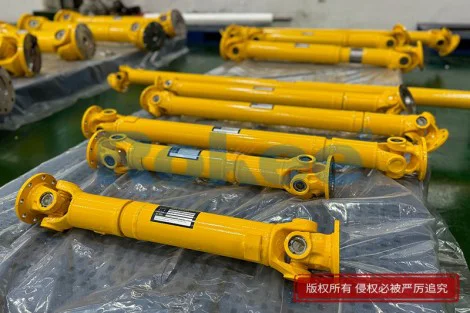
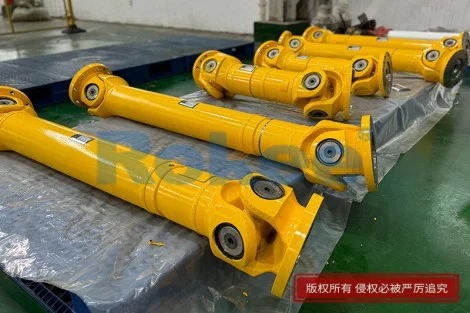
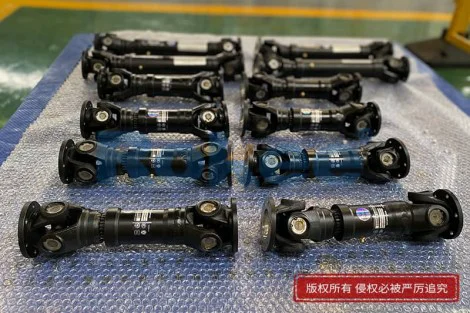
The cardan driveshaft, with its unique structural advantages, perfectly meets these requirements. A typical cardan driveshaft consists of two universal joints (cross joints) and a central shaft, and some models are equipped with spline connections to enhance flexibility. The universal joint, composed of a cross shaft and bearings, allows the driveshaft to transmit power between two shafts that are not on the same axis, compensating for angular deviations caused by the layout of the production line and equipment installation limitations. This is particularly important for sandwich panel production machines, as the layout of each subsystem is often not on the same axis due to the constraints of the production process and the overall structure of the equipment. For example, the uncoiling system and the roll forming system are often installed at different heights and angles, and the cardan driveshaft can smoothly transmit power between these two subsystems without being affected by angular deviations, ensuring the synchronization of the entire production process. In addition, the spline connection design of some cardan driveshafts can compensate for axial displacement caused by thermal expansion and contraction of equipment during long-term operation or changes in the relative position of shafts due to vibration, further improving the stability and reliability of power transmission.
Durability is a key characteristic that makes cardan driveshafts suitable for long-term use in sandwich panel production machines. Sandwich panel production typically requires continuous operation for long hours, even around the clock, which means that the cardan driveshaft must withstand continuous torque transmission and resist wear, fatigue, and corrosion. To achieve high durability, the materials used in the manufacturing of cardan driveshafts are carefully selected and processed. The central shaft and universal joint components are usually made of high-strength heat-treated steel, which undergoes processes such as quenching and tempering to enhance its hardness, toughness, and wear resistance. This allows the driveshaft to withstand high torques and continuous loads without deformation or damage. The bearings in the universal joint are made of high-precision wear-resistant materials, and are equipped with effective sealing structures to prevent dust, grease, and other contaminants from entering, reducing wear and extending the service life of the bearings. In addition, the surface of the cardan driveshaft is often treated with anti-corrosion coatings, such as galvanizing or powder coating, to resist corrosion caused by moisture, dust, and chemical substances in the production environment, ensuring that the driveshaft can maintain stable performance even in harsh working conditions.
The adaptability of cardan driveshafts is another important factor that makes them suitable for various sandwich panel production machines. Sandwich panel production machines come in a variety of types and specifications, depending on the type of core material (such as polyurethane, rock wool, glass wool, polystyrene), the thickness and width of the panels, and the production capacity. Different types of production machines have different requirements for power transmission, such as torque, speed, and installation space. Cardan driveshafts can be flexibly designed and adjusted according to these different requirements to achieve perfect matching. For example, for small and medium-sized sandwich panel production machines with low torque requirements, lightweight cardan driveshafts with compact structures can be used to save installation space and reduce energy consumption; for large-scale production lines with high torque and high speed requirements, heavy-duty cardan driveshafts with enhanced structural strength can be customized to ensure stable power transmission. In addition, cardan driveshafts can be designed with different lengths, connection methods, and angular compensation ranges to adapt to the layout and installation needs of different production machines, whether it is a horizontal production line, a vertical production line, or a production line with complex spatial layout, the cardan driveshaft can provide a suitable power transmission solution.
In the actual operation of sandwich panel production machines, the stable performance of cardan driveshafts directly affects the quality of the finished sandwich panels. For example, in the foaming and lamination processes of polyurethane sandwich panels, even slight fluctuations in transmission speed or torque will affect the density of the polyurethane foam core and the bonding effect between the core and the facing materials, leading to uneven panel thickness, poor bonding strength, and other quality defects. The cardan driveshaft, with its high-precision power transmission performance, can ensure that the torque and speed remain stable during transmission, even when there are angular deviations or axial displacements between the shafts. This stable power transmission ensures that each process of the production line operates in a synchronized and uniform manner, improving the consistency of product quality and reducing the rate of defective products. In addition, the cardan driveshaft has good shock absorption and buffering performance, which can absorb the vibration generated by the operation of the equipment, reduce the impact of vibration on the power transmission system and other components of the production machine, and extend the service life of the entire production line.
Another advantage of cardan driveshafts in sandwich panel production machines is their ease of maintenance, which further enhances their practical value in industrial production. As mentioned earlier, cardan driveshafts have a modular design, and their components such as universal joints, bearings, and splines can be easily inspected, maintained, or replaced when necessary. This reduces the downtime of the production line caused by component failure, ensuring the continuity of production. For example, during regular maintenance, operators only need to check the lubrication of the bearings, the wear of the splines, and the tightness of the connections, and add lubricating grease or replace worn components in a timely manner to ensure the normal operation of the cardan driveshaft. Compared with other complex power transmission components, the maintenance process of cardan driveshafts is simple, requiring no professional equipment or complex technical operations, which reduces the maintenance cost and labor intensity for enterprises.
It is worth noting that the performance of cardan driveshafts is closely related to their installation and maintenance. Improper installation or lack of regular maintenance will affect the durability and stability of the driveshaft, and even lead to component failure. Therefore, when installing the cardan driveshaft, it is necessary to ensure accurate alignment of the two connected shafts, control the angular deviation within a reasonable range (usually no more than 3 degrees), and fasten the connection bolts according to the specified torque to avoid loosening during operation. In terms of maintenance, regular lubrication is crucial. The bearings and splines of the cardan driveshaft need to be lubricated regularly with high-quality lubricating grease that meets the requirements (such as lithium-based extreme pressure grease conforming to NLGI 1 or 2 specifications). The lubrication cycle should be adjusted according to the working environment and operation time. For example, in harsh environments with high dust and high temperature, the lubrication cycle should be shortened to ensure that the components are fully lubricated, reducing wear caused by dry friction. In addition, it is necessary to regularly clean the surface of the cardan driveshaft, check for signs of corrosion, wear, or deformation, and take corresponding maintenance measures in a timely manner to avoid minor problems developing into major failures.
In the context of the continuous development of the sandwich panel industry, the requirements for production efficiency, product quality, and equipment reliability are constantly increasing, which puts higher demands on the power transmission components of production machines. Durable cardan driveshafts, with their excellent structural design, high durability, strong adaptability, and easy maintenance, have become an indispensable core component in various sandwich panel production machines. They not only ensure the stable and efficient operation of the production line but also help enterprises reduce production costs, improve product quality, and enhance market competitiveness. Whether it is a polyurethane sandwich panel production line, a rock wool sandwich panel production line, or a composite sandwich panel production line with multiple core materials, the cardan driveshaft can provide reliable power transmission support, adapting to the diverse needs of different production processes and equipment specifications.
In conclusion, the durable cardan driveshaft is a key power transmission component that is highly suitable for various sandwich panel production machines. Its unique structural advantages enable it to effectively compensate for angular and axial deviations between shafts, transmit torque stably and efficiently, and withstand the harsh working environment of long-term continuous operation. The careful selection of materials and precision processing ensure its high durability and long service life, while its flexible design and easy maintenance make it adaptable to different types and specifications of sandwich panel production machines. With the continuous progress of industrial technology, the design and manufacturing level of cardan driveshafts will continue to improve, providing more reliable and efficient power transmission solutions for the sandwich panel production industry, promoting the sustainable development of the industry and the upgrading of production technology. As an essential part of the sandwich panel production line, the durable cardan driveshaft will continue to play an important role in improving production efficiency, ensuring product quality, and reducing enterprise costs, becoming a powerful guarantee for the healthy development of the sandwich panel manufacturing industry.