Cardan Driveshaft Adapts To PU Sandwich Panel Machine For More Stable Transmission
In the realm of modern industrial manufacturing, the production of PU sandwich panels has become increasingly crucial due to their excellent thermal insulation, soundproofing, and structural stability, making them widely used in construction, cold storage, and prefabricated building projects. The PU sandwich panel machine, as the core equipment for mass production of these panels, relies heavily on a stable and efficient transmission system to ensure the consistency of product quality and the continuity of the production process. Among the various components that constitute the transmission system, the cardan driveshaft stands out as a key element that significantly enhances transmission stability, adapting perfectly to the complex working conditions of PU sandwich panel machines and addressing the inherent challenges of power transmission in such equipment.
To understand how the cardan driveshaft achieves stable transmission when adapted to PU sandwich panel machines, it is first necessary to clarify the working characteristics of PU sandwich panel machines and the core requirements for their transmission systems. A typical PU sandwich panel machine is a complex integrated production line that integrates multiple processes, including uncoiling of facing materials, surface pretreatment, PU foam mixing and pouring, lamination, curing, and cutting. Each process requires precise coordination and stable power input to ensure that every link operates in sync. The facing materials, which can be color steel sheets, aluminum sheets, or other substrates, need to be uncoiled and fed at a constant speed to avoid wrinkles or deformation; the PU foam mixing system requires stable power to maintain accurate mixing ratios and uniform pouring; the lamination and curing processes rely on consistent power transmission to ensure the bonding strength between the facing materials and the foam core; and the cutting system needs stable torque to achieve precise cutting without damaging the panel structure. Any instability in the transmission system can lead to defects such as uneven panel thickness, poor bonding, irregular cutting, and even production interruptions, resulting in increased production costs and reduced product qualification rates.
The traditional transmission components used in some PU sandwich panel machines often face limitations in adapting to the complex working environment of the equipment. For example, rigid driveshafts require strict coaxial alignment between the driving and driven shafts, but in the actual layout of PU sandwich panel machines, due to the integration of multiple functional modules, the installation positions of each power unit are often not on the same axis, leading to angular deviations between the shafts. This misalignment can cause excessive wear of rigid driveshafts, increased vibration, and even breakage under long-term operation, affecting the stability of the entire production line. In addition, during the continuous operation of the PU sandwich panel machine, the equipment will generate vibration and thermal expansion, which will further change the relative position of the shafts, requiring the transmission component to have a certain compensation capacity to adapt to these dynamic changes. The cardan driveshaft, with its unique structural design and excellent performance, effectively addresses these challenges, providing a reliable solution for stable transmission in PU sandwich panel machines.
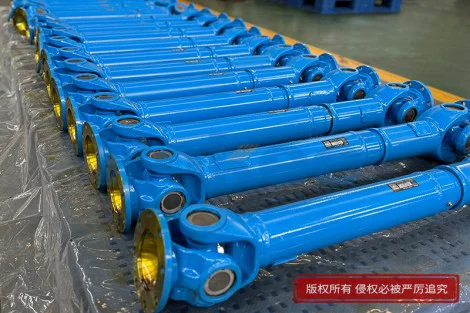
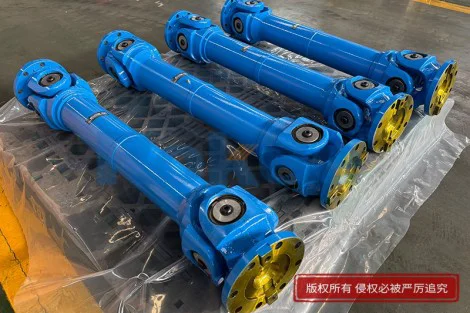
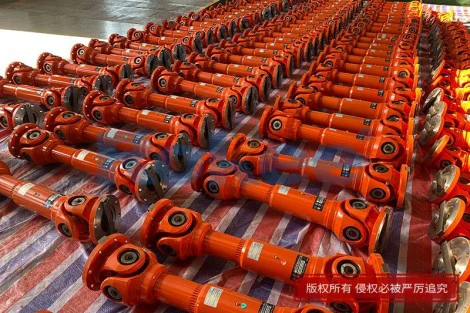
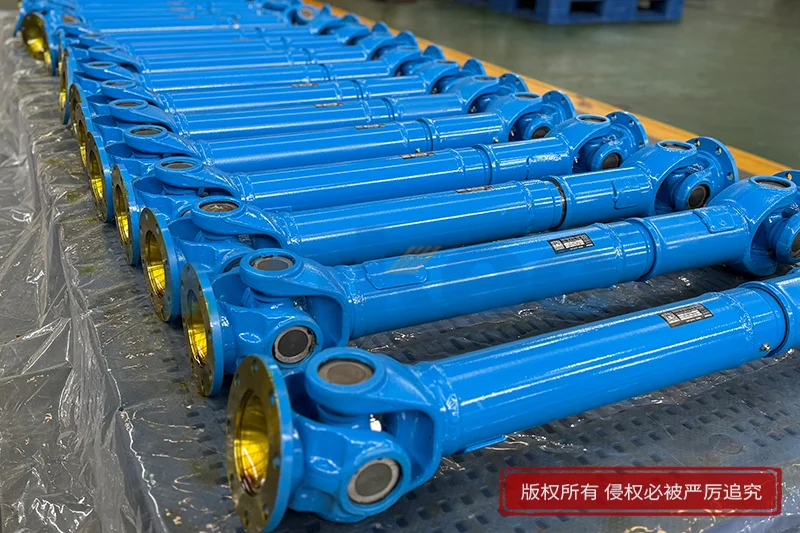
The cardan driveshaft, also known as the universal joint driveshaft, is a flexible mechanical component designed to transmit rotational motion and torque between two shafts that are not aligned or have angular deviations. Its basic structure consists of two yokes connected by a cross-shaped intermediate member, with precision bearings installed at the connection points to ensure smooth rotation. This structural design allows the cardan driveshaft to compensate for angular misalignment, axial displacement, and radial deviation between the driving and driven shafts, enabling stable power transmission even under conditions of misalignment. In the context of PU sandwich panel machines, this flexibility is particularly important, as it allows the driveshaft to adapt to the layout characteristics of the equipment’s multiple modules, eliminating the need for strict coaxial alignment during installation and reducing the difficulty of equipment assembly and maintenance.
One of the key advantages of the cardan driveshaft when adapted to PU sandwich panel machines is its ability to maintain constant angular velocity during power transmission. The double cardan driveshaft, a common type used in industrial applications, uses two universal joints connected by an intermediate shaft, with the second universal joint phased 90 degrees relative to the first to cancel out the variable angular velocity caused by single universal joints. This configuration ensures that the driven shaft rotates at the same constant speed as the driving shaft, even when there is an angular deviation between the two shafts. For PU sandwich panel machines, this constant angular velocity transmission is critical, especially in the foam mixing and pouring process. The metering pumps in the foam mixing system require stable power input to accurately control the ratio of polyol, isocyanate, and other additives, ensuring the consistency of the foam density and performance. Any fluctuation in the transmission speed will lead to inaccurate mixing ratios, resulting in foam core defects such as uneven density, poor thermal insulation, and reduced structural strength. The cardan driveshaft’s ability to maintain stable speed transmission effectively avoids such problems, ensuring the quality of the PU foam core.
Another important feature of the cardan driveshaft that makes it suitable for PU sandwich panel machines is its robust construction and high load-bearing capacity. PU sandwich panel machines often operate continuously for long periods, with the transmission system bearing high torque loads, especially during the lamination and cutting processes. The lamination system requires sufficient torque to press the facing materials and foam core together tightly, ensuring strong bonding, while the cutting system needs stable torque to cut through the solidified panels efficiently. The cardan driveshaft is typically made of high-grade steel or aluminum alloy, undergoing precision machining and heat treatment to enhance its mechanical strength and wear resistance. The cross-shaped intermediate member and precision bearings are designed to withstand high torque and repeated mechanical stress, ensuring long-term reliable operation under heavy-load conditions. Compared to traditional transmission components, the cardan driveshaft has a longer service life and lower maintenance requirements, reducing the downtime of the PU sandwich panel machine and improving production efficiency.
Vibration reduction is another key benefit of adapting the cardan driveshaft to PU sandwich panel machines. During the operation of PU sandwich panel machines, the uncoiling of facing materials, the rotation of rollers, and the operation of pumps will generate vibration, which can be transmitted through the transmission system to other parts of the equipment, affecting the stability of the production process and the quality of the finished panels. Excessive vibration can cause the foam pouring nozzle to deviate, leading to uneven foam distribution; it can also cause the cutting blade to shake, resulting in irregular cutting edges. The cardan driveshaft’s flexible structure has a certain shock absorption effect, which can absorb and dampen the vibration generated during operation, reducing the impact of vibration on the transmission system and the entire equipment. The precision bearings in the cardan driveshaft also reduce friction during rotation, further reducing vibration and noise, creating a more stable working environment for the PU sandwich panel machine.
The adaptability of the cardan driveshaft to different working conditions is also an important factor in its application in PU sandwich panel machines. PU sandwich panel machines need to produce panels of different thicknesses and widths according to different production requirements, which requires the transmission system to be adjustable and adaptable. The cardan driveshaft can be customized in length and structure according to the specific layout and power requirements of the PU sandwich panel machine, ensuring a perfect fit with the equipment. In addition, the cardan driveshaft can adapt to changes in the operating speed of the PU sandwich panel machine, maintaining stable transmission even when the production speed is adjusted. This adaptability allows the PU sandwich panel machine to achieve flexible production, meeting the diverse needs of different customers and markets.
In practical applications, the adaptation of the cardan driveshaft to PU sandwich panel machines has been proven to significantly improve transmission stability and production efficiency. For example, in a large-scale PU sandwich panel production line, after replacing the traditional rigid driveshaft with a cardan driveshaft, the vibration of the equipment was reduced by more than 30%, the product qualification rate increased by 15%, and the downtime due to transmission failures was reduced by nearly 50%. The cardan driveshaft effectively compensated for the angular misalignment between the power units of the production line, ensuring that each process operated in sync. The stable transmission of the cardan driveshaft also ensured the consistency of the foam core density and the flatness of the panel surface, improving the overall quality of the PU sandwich panels.
The long-term reliability of the cardan driveshaft also brings significant economic benefits to the operation of PU sandwich panel machines. Due to its robust construction and low maintenance requirements, the cardan driveshaft reduces the frequency of component replacement and maintenance, lowering the operating costs of the equipment. The reduced downtime also increases the effective production time of the PU sandwich panel machine, improving the overall production capacity. In addition, the stable transmission of the cardan driveshaft reduces the wear of other components in the transmission system, extending the service life of the entire equipment and further reducing the total cost of ownership.
As the demand for PU sandwich panels continues to grow, the requirements for the stability and efficiency of PU sandwich panel machines are also increasing. The cardan driveshaft, with its unique advantages of flexibility, stable transmission, high load-bearing capacity, and vibration reduction, has become an indispensable component in the transmission system of modern PU sandwich panel machines. Its adaptation to PU sandwich panel machines not only solves the inherent problems of traditional transmission components but also provides a reliable guarantee for the high-quality and efficient production of PU sandwich panels.
In conclusion, the adaptation of the cardan driveshaft to PU sandwich panel machines is a crucial innovation in the field of PU sandwich panel production. By leveraging its flexible structural design, constant angular velocity transmission, robust construction, and vibration reduction capabilities, the cardan driveshaft significantly improves the stability of the transmission system, ensuring the consistency of product quality and the continuity of the production process. As industrial manufacturing continues to develop towards automation and high efficiency, the cardan driveshaft will play an even more important role in the optimization of PU sandwich panel machines, promoting the sustainable development of the PU sandwich panel industry. Its ability to adapt to complex working conditions and meet diverse production needs makes it a key component that enhances the competitiveness of PU sandwich panel production enterprises, helping them achieve higher efficiency, better quality, and lower costs in the fiercely competitive market.