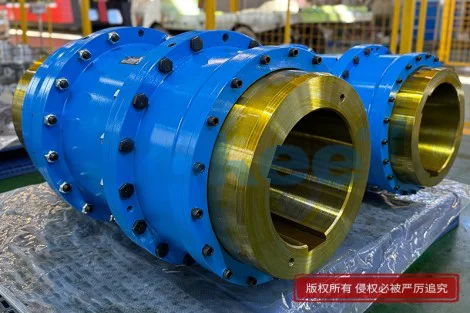
Gear Coupling Is Indispensable to Smooth Operation Of Continuous PU Sandwich Panel Production Line

A continuous PU sandwich panel production line represents one of the most demanding environments in modern building-materials manufacturing, where every meter of moving panel must travel at a tightly synchronized speed through feeding, foaming, curing, laminating, cutting, and stacking stations. The mechanical heart that keeps this complex choreography in step is the drive train, and within that train the gear coupling plays a quiet but non-negotiable role. Unlike belts, chains, or flexible elastomeric inserts that can slip, stretch, or fatigue under prolonged torque, a gear coupling transmits power through meshed teeth cut into inner and outer hubs, combining high torsional stiffness with controlled angular and parallel misalignment accommodation. In a PU line, where the two facing metal skins—typically pre-painted steel, aluminum, or sometimes stainless—must meet the chemical reaction of the polyurethane foam within a tolerance of millimeters, any loss of synchronization between the upper and lower belt drives translates immediately into uneven core density, wavy panel surfaces, broken skin adhesion, or scrap running the full length of a ten-meter-plus oven. The gear coupling becomes, in effect, the mechanical translator between the electric or hydraulic motor's rotational energy and the precisely regulated linear motion that the panel demands. Without it, the line cannot hold the velocity profile that the exothermic foaming reaction requires, and the entire continuous process reverts to a stop-start, batch-by-batch operation that destroys both productivity and quality.
The first reason gear couplings prove indispensable on a continuous PU line lies in their extraordinary torque density. PU sandwich panels, especially the thicker 100 mm to 200 mm insulating grades used in cold storage and cleanroom construction, carry a foam core that resists the progressive compression of the double belt press. The belt itself is driven by multiple motorized stations along the oven length, each connected through a gearbox to a long drive shaft that runs the width of the line. At the higher end of production speed—often 8 to 15 meters per minute depending on panel thickness—the instantaneous torque required to overcome belt friction, panel adhesion, and thermal expansion of the steel strip can spike well beyond the continuous rating of simpler coupling types. A gear coupling, because its teeth share the load across a full circumferential contact path, can transmit three to five times more torque per unit diameter than a jaw-type or disk coupling of the same envelope. This density matters on a PU line because space above and beside the belt is at a premium: operators need access for splice replacement, the chemical dispenser must track along the moving panel, and the edge-trimming units sit directly beside the drive end. A compact, high-torque gear coupling lets the engineer place the motor and gearbox where workflow demands rather than where a bulky coupling would otherwise force them, preserving the maintainability that a 24/7 production schedule absolutely requires.
Beyond raw torque, the gear coupling's real advantage emerges under misalignment conditions that are unavoidable in a line as long and as thermally active as a PU oven. A continuous PU press can stretch 40 to 60 meters from the entrance feed table to the exit saw. Along that length, the steel belt itself expands and contracts by several millimeters as it cycles between room-temperature entry and 50 to 60 degree oven core temperature. The drive shafts that connect gearboxes across the width of the line are mounted on frames that weld, bolt, and settle under years of thermal cycling, shifting by fractions of a degree between cold start and steady-state operation. If the coupling were perfectly rigid, these tiny misalignments would convert into massive bending forces on the bearing, shaft keyway, and gearbox seal, causing premature failure within weeks. A gear coupling solves this because the crowned or barreled tooth form on the outer sleeve allows the shaft hub to articulate through a small angular offset while still maintaining full tooth engagement. The sliding motion between teeth also permits a degree of axial float, absorbing the thermal growth of long drive shafts without imposing thrust load on the motor. On a PU line, where a single unplanned shutdown can waste hundreds of meters of foam-infused panel and require an hour or more of oven cleaning, this tolerance of misalignment is not a convenience—it is the factor that separates a line that runs for months between overhauls from one that sits idle every other week.
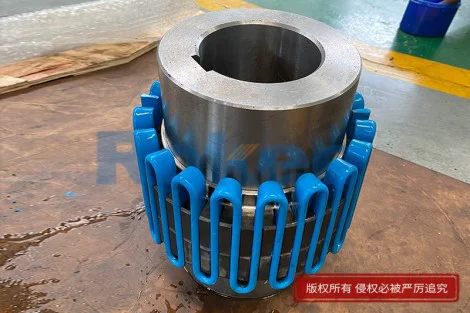
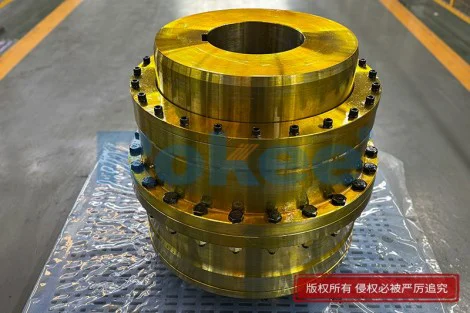
The material science behind gear couplings has evolved specifically to survive the contaminate-rich atmosphere of a PU sandwich panel factory. Polyurethane chemistry involves isocyanate, polyol, blowing agents, catalysts, and sometimes flame-retardant additives that, when dispensed and cured, can produce fine aerosols and overspray that drift onto every mechanical component within several meters of the foaming head. Add to that the steel-strip lubricants, the cutting dust from the exit saw, and the occasional water used to clean the lamination rollers, and the operating environment becomes abrasive, chemically active, and frequently wet. A gear coupling is typically enclosed in a rigid metal cover packed with lithium or molybdenum-disulfide grease that is selected specifically for its resistance to water washout and its ability to form an elastohydrodynamic film between meshing steel teeth. The cover also keeps the external atmosphere away from the contact zone, extending tooth life far beyond what an exposed coupling could achieve. In PU plants that operate in coastal or humid climates, the sealed gear coupling often outlasts the line's other drive components by a factor of two or three, precisely because it was engineered from the start to contain its own lubrication and exclude the hostile outside environment. Without this sealed, grease-lubricated architecture, the line operator would be forced to shut down drive stations far more frequently to repack, clean, and re-grease exposed friction elements—downtime that directly contradicts the economics of continuous panel production.
Synchronization between the upper and lower belts of a PU sandwich press is the single most critical quality variable in the entire process, and it is here that the gear coupling's torsional rigidity becomes irreplaceable. When the two steel skins enter the press with the freshly dispensed PU foam between them, the chemical reaction begins almost immediately: the liquid mixture expands, rises, and cures into a rigid cellular structure within 30 to 90 seconds depending on formulation and oven temperature. If the upper belt travels even 0.5 percent faster or slower than the lower belt during this window, the foam core shears internally, the skins delaminate locally, or the panel exits the oven with a curved, banana-shaped profile that fails the flatness inspection. Elastomeric or bellows couplings, though excellent for high-speed precision machinery, introduce measurable torsional wind-up under load—that is, the input shaft rotates slightly before the output shaft catches up, because the elastic element stores and releases energy like a spring. On a long PU line with multiple driven stations, that wind-up accumulates at every joint, and the accumulated phase error between belt ends is enough to ruin panel quality. A gear coupling, by contrast, transmits torque through rigid metal tooth contact with essentially zero torsional backlash and zero wind-up. The motor commands a rotation, and the belt pulley receives that rotation within microns of angular position. This mechanical certainty is what allows modern PU lines to hold panel length tolerance to under one millimeter per meter and skin-to-core adhesion at the levels required by architectural and cold-room applications. It is not an exaggeration to say that the gear coupling is the component that makes continuous PU sandwich panel quality reproducible at industrial scale.
Maintenance access and human factors also play a decisive role in why gear couplings remain the default choice on PU lines rather than newer, more fashionable coupling technologies. A PU press runs in three shifts, often six or seven days a week, and the maintenance team is typically a small crew of generalists rather than coupling specialists. When a gear coupling needs service, the procedure is straightforward: remove the cover bolts, slide the sleeve off the hubs, inspect tooth wear with a simple feeler gauge or visual reference, repack with the specified grease, and reassemble. Replacement parts—sleeves, seals, gaskets—are standardized across manufacturers and can be kept on the shelf as spares, so that a worn coupling does not require a lead time of weeks from an overseas supplier. The gear coupling also tolerates, within reason, the imperfect installation habits of field mechanics: a shaft pulled out a few millimeters too far during belt change, a gearbox realigned by eye rather than laser, a cover bolted with slightly uneven torque—none of these minor errors destroy a gear coupling the way they would destroy a precision disk pack or a thin stainless bellows. On a production line where maintenance windows are measured in hours and a missed splice can mean a four-hour oven cool-down, this robustness is a strategic advantage. The plant manager who chooses gear couplings is choosing a drive component that the local crew can understand, service, and trust, rather than one that requires a specialist visit every time something drifts out of spec.
The dynamic behavior of a PU line under start-up, speed change, and emergency stop further reinforces the necessity of a coupling that can absorb transient shock without damage. Consider what happens when the exit saw detects a panel end and signals the entire line to decelerate from 12 meters per minute to a crawl, then accelerate back to full speed for the next panel. The inertia of a 60-meter steel belt, the weight of the pressed foam, and the friction of the support rollers combine into a massive rotational inertia at every drive shaft. When the motor applies torque to change speed, that inertia resists, producing a torque spike at the coupling that can reach two to three times the running load. Even more demanding is the emergency stop, triggered by a skin break, a foam blockage, or a safety interlock, where the controlled drive ramps down as fast as the inverters permit but the belt's momentum continues to carry it forward. A gear coupling's tooth design is engineered with a safety factor that absorbs these spikes as short-duration overloads, because the contact stress between curved teeth distributes the impact across a wide surface. The coupling may suffer a tiny amount of plastic deformation at the tooth root on a particularly hard stop, but it will not crack, shear, or shatter the way a brittle elastomeric insert might. This shock tolerance is what protects the line's more expensive components—the gearboxes, the servo motors, the precision belt rollers—from being destroyed by the very transients that continuous production inevitably generates. Without it, every emergency stop would become a gearbox rebuild, an economic impossibility in a high-utilization plant.
Thermal management of the drive train is another dimension where the gear coupling earns its place. Inside the press oven, the ambient air around the belt reaches 40 to 55 degrees, and the steel strip itself can run hotter than the surrounding air because of the exothermic PU reaction. Drive shafts that pass through the oven walls conduct heat outward toward the gearbox and coupling, raising the coupling's operating temperature well above the 20 to 30 degree ambient typical of general machinery. A gear coupling's grease lubricant is chosen to remain effective up to 120 or even 150 degrees continuously, and the metal cover acts as a heat sink that dissipates some of the conducted warmth before it reaches the gearbox oil seal. The rolling and sliding contact between teeth also generates frictional heat, but because the tooth pressure is distributed across a large engaged area and the grease film separates the asperities, the heat per unit area stays low enough that the coupling does not run hot to the touch after hours of operation. Compare this with a dry-running polymer coupling, which can soften, creep, or emit fumes at sustained oven-side temperatures, or a belt drive that loses tension as it warps. The gear coupling simply continues to rotate, its lubrication stable, its tooth geometry unchanged, its alignment unaffected by the heat that the rest of the line must carefully engineer around. This thermal indifference allows the line designer to place drive stations closer to the oven zone, shortening the overall press length and reducing the capital cost of the building that houses the line.
Spare-parts strategy and supply-chain resilience are often overlooked when engineers select a coupling for a new PU line, but they become existential once the line is running. A PU sandwich panel plant is usually a high-fixed-cost operation: the building, the steel decoilers, the chemical storage, the oven, and the downstream cutting and stacking equipment represent an investment measured in millions, and the plant's profitability depends on running that equipment at 90 percent utilization or higher. If the coupling between the motor and the belt pulley requires a proprietary part number, a long-lead-time import, or a specialized reconditioning service, then a single tooth failure can idle the entire line for weeks. The gear coupling, by contrast, has been a standardized industrial component for decades, and its design parameters—bore diameter, tooth pitch, sleeve length, keyway dimensions—are produced by hundreds of manufacturers on every continent. A plant in Southeast Asia, the Middle East, Eastern Europe, or South America can source a compatible replacement sleeve or a complete coupling from a local distributor within days, often off the shelf. The maintenance team can also cross-reference the wear pattern on the old teeth against generic service manuals, and can even machine a replacement sleeve in their own workshop if necessary, because the geometry is well understood. This supply-chain universality means that the gear coupling is the lowest-risk possible choice for a PU line, in the same way that a standard bolt is preferred over a custom fastener on a pressure vessel: not because it performs the best in a laboratory, but because it can be replaced without holding the entire production schedule hostage.
Looking forward, the trend in PU sandwich panel manufacturing toward ever-faster lines, thicker and more thermally efficient panels, and tighter tolerances on flatness and edge squareness only increases the demand for a coupling that combines torque density, zero backlash, misalignment tolerance, sealed lubrication, and field-serviceability. Newer production concepts—double-band presses with independent zone control, in-line lamination of decorative films, continuous profiling of insulation grades—all add more driven shafts, more synchronization points, and more transient loads to the drive train. Some of these stations, particularly the high-speed foil feeding and the edge-sealing units, may benefit from precision disk or bellows couplings where backlash must be near zero at very low torque. But the main belt drives, the decoiler traction drives, the foam head traverse, and the exit conveyor will continue to rely on gear couplings, because no competing technology has yet matched their combination of power density, durability, and simplicity. A continuous PU sandwich panel line is, in the end, a synchronized mechanical orchestra, and the gear coupling is its jointed skeleton—unyielding where it must transmit force, flexible where it must absorb the small misalignments that reality always introduces. Remove it, and the line loses the mechanical certainty that makes continuous production possible; keep it well maintained, and the line will run for years, meter after meter, panel after panel, delivering the consistent insulating panels that modern buildings, cold stores, and cleanrooms depend on. It is, in every practical sense, indispensable.