PUR Sandwich Panel Production Line Runs More Smoothly With Curved Tooth Coupling

The continuous operation stability of a PUR sandwich panel production line directly determines the consistency of finished product quality, production efficiency, and long-term operational cost of the entire manufacturing system. PUR sandwich panels, as high-performance thermal insulation and structural building materials, require precise and continuous production processes including raw material feeding, high-pressure foaming, continuous laminating, fixed-length cutting, and finished product conveying. Every link in the production line relies on stable power transmission and coordinated mechanical operation, and subtle fluctuations in power output, shaft misalignment, or mechanical vibration will be amplified in continuous industrial production, leading to uneven foaming density, inconsistent panel surface flatness, dimensional deviation of finished products, and even frequent equipment shutdowns and component wear. In the core power transmission structure of modern PUR sandwich panel production lines, curved tooth coupling has gradually replaced traditional coupling structures and become a key component to optimize the overall operating state of the equipment, bringing more stable, efficient and low-consumption operating performance to the entire production line.
To understand the optimization effect of curved tooth coupling on PUR sandwich panel production line, it is necessary to first analyze the mechanical operation pain points of traditional production line power transmission systems. Most early PUR sandwich panel production equipment adopts straight tooth couplings or rigid connection structures for power transmission between driving motors, reduction gearboxes, transmission shafts and execution components. Although these traditional structures can realize basic torque transmission, they have obvious inherent defects in long-term continuous industrial operation. In the high-load continuous production scenario of sandwich panels, the equipment will inevitably produce tiny axial, radial and angular shaft misalignment due to long-term vibration, mechanical thermal expansion and contraction, and assembly tolerance accumulation. Traditional straight tooth couplings are prone to edge pressure and local stress concentration when bearing misalignment, which will cause uneven tooth surface friction, accelerated wear of transmission components, and unstable torque output. This unstable power transmission state will directly affect the operating rhythm of key equipment such as laminating rollers and conveyor platforms. The slight jitter and speed fluctuation of the rollers will lead to inconsistent extrusion pressure during PUR foaming and laminating, resulting in partial hollowing, uneven thickness and unsmooth surface of the sandwich panel, reducing the yield of finished products.
In addition, the poor vibration buffering performance of traditional couplings further exacerbates the operating loss of the production line. The start-stop impact of the motor, the load fluctuation during raw material feeding and foaming, and the mechanical resonance generated by high-speed operation will form periodic vibration and shock loads in the transmission system. Traditional rigid transmission structures cannot effectively absorb and dissipate these vibrations, resulting in the vibration being transmitted to the entire equipment frame and processing components. Long-term vibration impact will not only loosen the assembly structure of the production line, increase equipment failure rates, but also cause fatigue wear of bearings, seals and other vulnerable parts, shortening the service cycle of core equipment and increasing daily maintenance workload and operating costs. At the same time, the unstable operating state will force enterprises to reduce the operating speed of the production line appropriately to reduce product defective rate, which seriously restricts the improvement of production efficiency and cannot meet the large-scale and high-precision production demand of modern PUR sandwich panels.
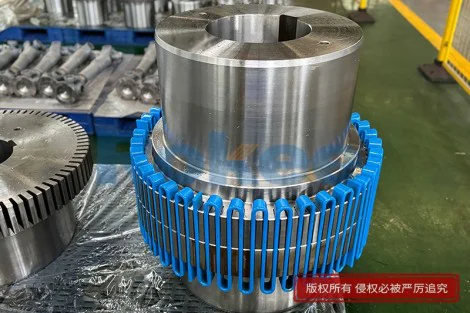
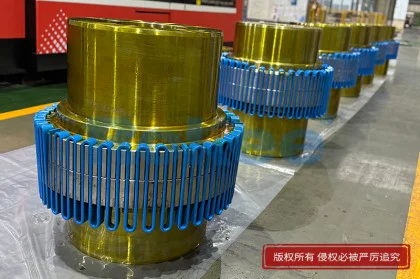
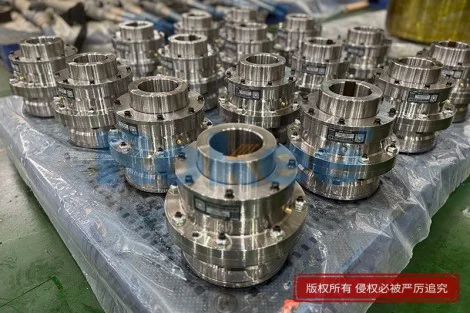
The structural design and working principle of curved tooth coupling perfectly solve the above pain points of traditional transmission structures, and adapt to the continuous and high-precision operating characteristics of PUR sandwich panel production lines. Different from the linear meshing mode of traditional straight tooth couplings, the tooth profile of curved tooth coupling adopts a special curved arc design. This unique structural feature enables the meshing teeth to achieve large-area uniform contact during power transmission, rather than local edge contact. When the production line operates with shaft misalignment caused by mechanical vibration, thermal deformation or assembly errors, the curved tooth structure can automatically adapt to axial, radial and angular displacement changes, avoiding edge pressure and local stress concentration in the transmission process. This flexible adaptive meshing state ensures that the torque transmission of the entire transmission system is always uniform and stable, eliminates the torque fluctuation and mechanical jitter caused by shaft misalignment, and provides a stable power foundation for the precise operation of each processing link of the PUR sandwich panel production line.
The excellent vibration damping and shock absorption performance of curved tooth coupling is another core advantage to optimize the operation of sandwich panel production lines. In the continuous production process, the PUR foaming and composite molding process has strict requirements on the stability of equipment operating speed and pressure. The instantaneous impact load generated by motor start, load switching and equipment operation will be effectively buffered and dissipated by the curved tooth meshing structure. The curved tooth contact mode can evenly disperse the instantaneous impact force on the entire tooth surface, avoid concentrated impact on local components, and significantly reduce the torsional vibration and mechanical noise of the transmission system. This vibration suppression effect can stabilize the operating state of key components such as laminating rollers and cutting tools, ensure that the extrusion pressure and operating speed remain consistent in the process of panel foaming and laminating, effectively avoid product quality problems such as uneven foaming, inconsistent panel thickness and surface wrinkles caused by mechanical vibration, and greatly improve the qualification rate and uniformity of finished PUR sandwich panels.
In terms of load bearing and continuous operation performance, curved tooth coupling shows higher stability and durability suitable for industrial continuous production. The large-area curved meshing structure enables the coupling to bear higher continuous torque and variable load, and the load is evenly distributed on each meshing tooth during operation, which avoids the problem of accelerated wear of individual teeth caused by excessive local load in traditional couplings. For PUR sandwich panel production lines that operate uninterruptedly for a long time, this uniform load-bearing performance can effectively reduce the fatigue wear of transmission components, slow down the aging speed of equipment, and maintain stable power transmission efficiency for a long time. Unlike traditional couplings that are prone to tooth surface wear, tooth breakage and transmission gap increase after long-term operation, curved tooth coupling can maintain precise meshing accuracy and stable torque transmission state in long-term high-load operation, avoiding production line jitter and product quality degradation caused by increased transmission gaps.
The optimized operation state brought by curved tooth coupling to the production line is also reflected in the reduction of equipment maintenance costs and the improvement of production continuity. The self-adaptive misalignment compensation capability and low-wear operating characteristics greatly reduce the failure frequency of the transmission system. The traditional coupling needs regular inspection, lubrication adjustment and component replacement due to serious wear and unstable transmission, which often requires production line shutdown for maintenance, resulting in production interruption and efficiency loss. After adopting curved tooth coupling, the wear degree of transmission components is significantly reduced, the service life of core transmission parts is extended, and the daily maintenance workload is greatly reduced. The production line can maintain long-term stable continuous operation, reduce unplanned shutdown time, and effectively improve the overall production capacity and operational efficiency of the production line. In addition, the stable mechanical operating state reduces the loose connection and abnormal wear of other matching components of the equipment, reduces the overall failure rate of the production line, and further optimizes the long-term operating cost of the production system.
From the perspective of product precision improvement, the stable transmission performance of curved tooth coupling provides accurate mechanical guarantee for the high-precision production of PUR sandwich panels. The production of high-quality PUR sandwich panels requires extremely high precision in the matching of feeding speed, foaming volume, laminating pressure and cutting size. Any tiny speed fluctuation or mechanical displacement deviation will affect the overall performance of the finished panel. For example, unstable operating speed will lead to uneven mixing of PUR raw materials, insufficient or excessive local foaming, and unbalanced laminating pressure will cause inconsistent bonding strength between the panel surface layer and the core material, affecting the thermal insulation performance and structural stability of the finished product. The curved tooth coupling eliminates the unstable factors in the power transmission link, realizes synchronous and accurate operation of each transmission shaft and execution component of the production line, ensures the consistency of each production process parameter, and makes the dimensional accuracy, surface flatness and internal structural uniformity of the produced PUR sandwich panels reach a higher level.
In the actual industrial production scenario, the application value of curved tooth coupling is also reflected in its strong adaptability to the operating environment of sandwich panel production lines. The production environment of PUR sandwich panels has certain characteristics of temperature change and dust accumulation. Long-term temperature change will cause thermal expansion and contraction of equipment components, resulting in shaft position deviation, while dust accumulation will increase the friction loss of transmission components. The curved tooth structure has good thermal deformation adaptability and dust resistance. Its flexible meshing state can adapt to the tiny position changes of components caused by temperature fluctuation, and the smooth curved tooth surface reduces the friction loss caused by dust accumulation, ensuring that the equipment can still maintain stable operating performance in complex industrial environments. This excellent environmental adaptability makes the production line have stronger operational stability and anti-interference ability, and can maintain consistent production quality and efficiency in long-term industrial batch production.
With the continuous upgrading of the manufacturing industry, the production of PUR sandwich panels is developing towards high precision, high efficiency and intelligent continuous production. The traditional mechanical transmission structure has become a bottleneck restricting the further improvement of production line performance. The application of curved tooth coupling optimizes the most basic and core power transmission link of the production line, solves many inherent problems of traditional transmission structures, and realizes comprehensive improvement in equipment operation stability, product quality consistency, production efficiency and equipment service life. It not only reduces the operating and maintenance costs of enterprises, but also provides a reliable mechanical foundation for the high-quality and large-scale production of PUR sandwich panels.
In conclusion, the curved tooth coupling, with its unique curved tooth meshing structure, excellent misalignment compensation ability, efficient vibration damping performance and durable low-wear operating characteristics, perfectly matches the continuous and high-precision production requirements of PUR sandwich panel production lines. It eliminates the unstable factors in the mechanical operation process, makes the entire production line run more smoothly and efficiently, effectively improves the comprehensive production performance of the equipment and the quality level of finished products, and has become an indispensable key component in the modernization and upgrading of PUR sandwich panel production equipment. With the continuous progress of mechanical manufacturing technology, the structural performance of curved tooth coupling will be further optimized, and its application effect in sandwich panel production lines will be more prominent, bringing more stable and efficient production guarantees for the building insulation material manufacturing industry.