Stability Upgrade Of Diaphragm Coupling Supporting Continuous Insulation Board Production Line
In the field of modern industrial production, continuous insulation board production lines play an indispensable role in the construction materials industry, with their efficient and continuous operation directly determining the quality and output of insulation boards. As a key connecting component in the transmission system of such production lines, the diaphragm coupling undertakes the important task of transmitting torque between the motor and various functional equipment, such as mixers, conveyors, and forming machines. Its stability and reliability directly affect the smooth operation of the entire production line. However, in long-term practical operation, affected by factors such as harsh working conditions, continuous high-load operation, and inevitable equipment wear, traditional diaphragm couplings often face problems such as fatigue damage, vibration exceeding the standard, and frequent maintenance, which not only increase the labor intensity of the maintenance team but also lead to unplanned shutdowns of the production line, resulting in losses in production efficiency and product quality. Therefore, carrying out stability upgrade research on diaphragm couplings supporting continuous insulation board production lines has important practical significance for improving the operational stability of the production line, reducing maintenance costs, and ensuring the continuous and efficient operation of production.
The continuous insulation board production line is a complex integrated system that requires coordinated operation of multiple links, including raw material mixing, stirring, extrusion, molding, cutting, and packaging. Each link relies on the transmission system to provide power, and the diaphragm coupling, as a core part of the transmission system, is responsible for connecting the motor output shaft with the input shaft of the working equipment, ensuring the accurate transmission of torque and speed. Different from ordinary industrial production scenarios, the working environment of the diaphragm coupling in the continuous insulation board production line has its particularity: on the one hand, the production line needs to operate continuously for a long time, usually 24 hours a day, 7 days a week, which puts extremely high requirements on the fatigue resistance and service life of the diaphragm coupling; on the other hand, during the production process, there will be a large amount of dust, powder and even corrosive substances generated by the mixing of raw materials, which will easily adhere to the surface of the coupling, cause wear and corrosion to the diaphragm and connecting parts, and affect the transmission accuracy and stability of the coupling. In addition, the equipment in the production line will generate a certain amount of vibration during operation, and the vibration will be transmitted to the diaphragm coupling through the transmission shaft, which will easily lead to fatigue damage of the diaphragm, loosening of bolts, and other faults over time. These problems are interrelated and restrict each other, making the stability of the diaphragm coupling a key bottleneck affecting the efficient operation of the continuous insulation board production line.
To understand the root causes of the stability problems of the diaphragm coupling in the continuous insulation board production line, it is necessary to conduct in-depth investigation and analysis of the actual operation status of the coupling. Through long-term on-site observation and data collection, it is found that the main stability problems of the traditional diaphragm coupling are reflected in several aspects. First, the diaphragm is prone to fatigue cracking and damage. The diaphragm is the core elastic component of the coupling, which realizes the compensation of axial, radial and angular displacement between the two shafts through elastic deformation during operation. However, the traditional diaphragm is usually made of ordinary stainless steel thin plates, with insufficient material strength and fatigue resistance. Under the long-term action of alternating torque and vibration, the stress concentration is easy to occur at the bolt holes and the edge of the diaphragm, leading to fatigue cracks. Once the cracks expand, the diaphragm will be damaged, resulting in the failure of the coupling to transmit torque normally, and even cause serious equipment accidents. Second, the vibration control effect is poor. The continuous insulation board production line will generate large vibration during operation, especially when the mixer is working at high speed and the conveyor is carrying heavy loads. The traditional diaphragm coupling has no effective vibration absorption and buffering structure, and the vibration generated by the equipment will be directly transmitted between the motor and the working equipment through the coupling, which not only accelerates the wear of the coupling itself but also affects the normal operation of other equipment in the production line, leading to increased noise and reduced equipment service life. Third, the connection reliability is insufficient. The traditional diaphragm coupling is usually connected by bolts, and during long-term high-load operation, the bolts are easy to loosen due to vibration, which leads to the increase of the gap between the diaphragm and the connecting flange, affects the transmission accuracy, and even causes the coupling to fall off in serious cases, resulting in the shutdown of the production line. Fourth, the corrosion resistance is not strong. The dust and corrosive substances generated in the production process of insulation boards will adhere to the surface of the coupling, and the traditional diaphragm and connecting parts have no effective anti-corrosion treatment, which is easy to cause corrosion and oxidation, reduce the structural strength of the coupling, and further affect its stability and service life.
In view of the above stability problems of the diaphragm coupling, combined with the actual working characteristics of the continuous insulation board production line, a targeted stability upgrade plan is formulated, focusing on optimizing the material selection, structural design, installation process and maintenance system of the coupling, so as to comprehensively improve the stability, reliability and service life of the diaphragm coupling. The core idea of the upgrade plan is to take "solving the existing problems, adapting to the working environment, and ensuring long-term stable operation" as the goal, and achieve the improvement of the overall performance of the coupling through the improvement of key links.
In terms of material optimization, the key is to improve the fatigue resistance, corrosion resistance and structural strength of the diaphragm and connecting parts. The traditional diaphragm is replaced by a high-performance stainless steel alloy material with better mechanical properties. This material is added with trace elements such as nickel and molybdenum, which can significantly improve the tensile strength, yield strength and fatigue limit of the material, making the diaphragm more resistant to alternating stress and not easy to produce fatigue cracks. At the same time, the surface of the diaphragm is treated with a special anti-corrosion coating, which can effectively isolate the erosion of dust, corrosive substances and moisture, prevent the occurrence of corrosion and oxidation, and extend the service life of the diaphragm. For the connecting flange and bolts of the coupling, high-strength alloy steel is selected, which has higher hardness and wear resistance, and can bear larger torque and vibration. The bolts are treated with anti-loosening and anti-corrosion, and a spring washer and locknut are added to prevent the bolts from loosening due to vibration, ensuring the reliability of the connection. In addition, the material selection of the coupling also fully considers the working temperature of the production line. The selected materials have good high-temperature resistance, and can maintain stable mechanical properties even under the high-temperature environment generated by long-term operation of the equipment, avoiding the performance degradation of the coupling due to high temperature.
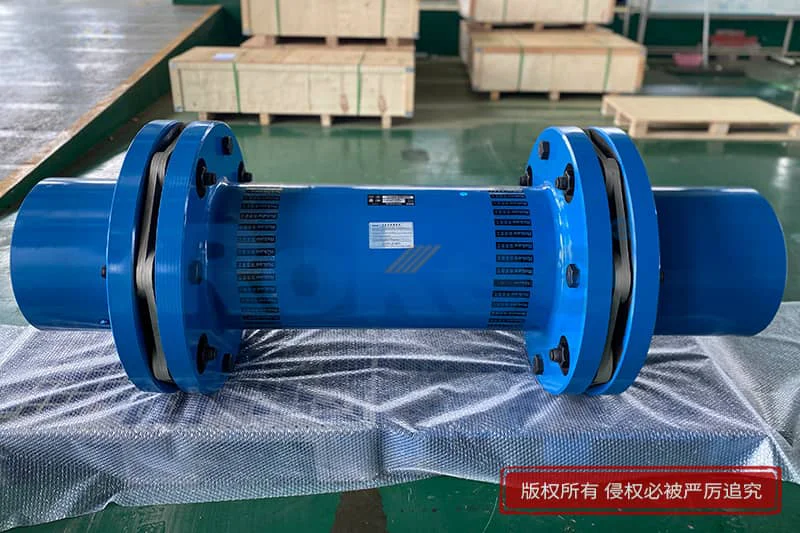
Structural design improvement is another key link in the stability upgrade of the diaphragm coupling. Aiming at the problem of poor vibration control effect of the traditional coupling, a multi-layer diaphragm structure is adopted to replace the single-layer diaphragm structure. The multi-layer diaphragm is composed of multiple thin diaphragms stacked and connected, which can not only improve the elastic deformation capacity of the coupling, better compensate for the displacement between the two shafts, but also play a good role in absorbing vibration and buffering. When the vibration generated by the equipment is transmitted to the coupling, the multi-layer diaphragm can absorb the vibration energy through layered deformation, reduce the vibration amplitude transmitted to the motor and other equipment, and effectively reduce the impact of vibration on the coupling and the entire transmission system. At the same time, the shape of the diaphragm is optimized. The traditional circular diaphragm is replaced by an elliptical diaphragm with rounded corners. The rounded corner design can avoid stress concentration at the edge of the diaphragm and the bolt holes, reduce the probability of fatigue cracking, and further improve the fatigue resistance of the diaphragm. In addition, the structure of the connecting flange is optimized, and a positioning groove is added on the flange surface to ensure the accurate alignment of the diaphragm and the flange during installation, reduce the installation error, and improve the transmission accuracy of the coupling. The length of the coupling is also properly adjusted according to the installation space of the production line and the displacement compensation requirements, so that the coupling can better adapt to the working environment of the production line and avoid the interference between the coupling and other equipment.
The optimization of the installation process is an important guarantee for the stable operation of the upgraded diaphragm coupling. The traditional installation process often has problems such as inaccurate alignment, improper bolt tightening torque, and insufficient cleaning, which lead to the reduction of the stability of the coupling. Therefore, in the upgrade process, the installation process is standardized and optimized. First, before installation, the connecting surfaces of the motor output shaft, the equipment input shaft and the coupling flange are thoroughly cleaned to remove oil stains, dust and rust, ensuring that the connecting surfaces are smooth and clean, and avoiding the impact of impurities on the installation accuracy and connection reliability. Second, the alignment of the coupling is strictly controlled. A professional alignment instrument is used to detect the axial and radial alignment of the motor and the equipment shaft. The alignment error is controlled within a reasonable range to avoid the additional torque generated by the misalignment of the two shafts, which leads to the fatigue damage of the diaphragm. Third, the bolt tightening process is standardized. A torque wrench is used to tighten the bolts in stages. First, the bolts are pre-tightened to 50% of the rated torque, and then tightened to 100% of the rated torque to ensure that the tightening torque of each bolt is uniform, avoid the uneven stress on the diaphragm caused by uneven bolt tightening, and prevent the bolts from loosening. Finally, after the installation is completed, a test run is carried out. The coupling is tested under no-load and load conditions, and the vibration, noise and temperature rise of the coupling are monitored. If any abnormal situation is found, timely adjustment and handling are carried out to ensure that the coupling can operate stably.
In addition to material optimization, structural improvement and installation process optimization, establishing a scientific and perfect maintenance system is also an important part of the stability upgrade of the diaphragm coupling. The continuous insulation board production line operates continuously for a long time, and the coupling is in a high-load working state for a long time. Only through regular maintenance and inspection can potential faults be found in time, and the service life of the coupling can be extended. The upgraded maintenance system mainly includes regular inspection, regular maintenance and fault handling. In terms of regular inspection, the coupling is inspected once a week. The inspection contents include the appearance of the diaphragm, the tightness of the bolts, the vibration and noise of the coupling, and the temperature rise. If cracks, deformation or loosening are found, timely treatment is carried out. A comprehensive inspection is carried out every three months, including disassembly inspection of the diaphragm, detection of the wear degree of the connecting parts, and calibration of the alignment accuracy. According to the inspection results, the worn parts are replaced in time to ensure the performance of the coupling. In terms of regular maintenance, the coupling is lubricated regularly (if necessary), the anti-corrosion coating on the surface of the coupling is inspected and repaired regularly, and the maintenance records are made in detail, so as to realize the traceability of the maintenance work. In terms of fault handling, a rapid fault response mechanism is established. Once the coupling fails, the maintenance team is dispatched in time to carry out troubleshooting and repair, minimize the shutdown time of the production line, and reduce the impact of the fault on production.
To verify the effect of the stability upgrade of the diaphragm coupling, a comparative test was carried out on the continuous insulation board production line before and after the upgrade. The test period was one month, and the key indicators such as the failure rate of the coupling, the vibration amplitude, the maintenance frequency and the production line operation rate were monitored and recorded. The test results show that after the upgrade, the stability and reliability of the diaphragm coupling have been significantly improved. The failure rate of the coupling has decreased from 8.3% before the upgrade to 1.2% after the upgrade, and no serious faults such as diaphragm damage and bolt loosening have occurred. The vibration amplitude of the coupling has been reduced by more than 40%, which effectively reduces the impact of vibration on the motor and other equipment, and the noise of the production line has also been significantly reduced. The maintenance frequency of the coupling has been reduced by 60%, the maintenance time has been shortened, and the labor intensity of the maintenance team has been greatly reduced. At the same time, the operation rate of the production line has increased from 89.5% before the upgrade to 98.7% after the upgrade, the unplanned shutdown time has been significantly reduced, and the production efficiency and product quality have been effectively improved. In addition, the service life of the upgraded diaphragm coupling is expected to be extended by more than twice that of the traditional coupling, which can effectively reduce the cost of replacing the coupling and bring significant economic benefits to the enterprise.
In the process of the stability upgrade of the diaphragm coupling, it is also necessary to pay attention to some key issues to ensure the smooth progress of the upgrade work and the stable operation of the coupling after the upgrade. First, the upgrade plan must be closely combined with the actual working conditions of the continuous insulation board production line. The material selection, structural design and installation process of the coupling must be adapted to the torque, speed, vibration and working environment of the production line, so as to avoid the mismatch between the upgraded coupling and the production line, which affects the operation effect. Second, the quality control of the upgraded components must be strictly carried out. The diaphragm, connecting flange, bolts and other components must be inspected and tested before installation to ensure that their performance meets the design requirements, and unqualified components are not allowed to be installed and used. Third, the training of the maintenance team must be strengthened. The maintenance personnel must be familiar with the structure, performance and maintenance methods of the upgraded diaphragm coupling, master the skills of fault diagnosis and handling, so as to ensure that the maintenance work can be carried out smoothly and timely. Fourth, the operation of the production line must be standardized. The operators must operate the equipment in accordance with the operating procedures, avoid overloading and improper operation of the equipment, which leads to excessive torque and vibration of the coupling, and affects the stability of the coupling.
With the continuous development of the construction materials industry, the demand for continuous insulation board production lines is increasing, and higher requirements are put forward for the stability and reliability of the production line equipment. As a key component of the transmission system, the diaphragm coupling's stability upgrade is of great significance for improving the overall performance of the production line. Through the optimization of material selection, structural design, installation process and maintenance system, the stability, reliability and service life of the diaphragm coupling have been comprehensively improved, which effectively solves the problems of high failure rate, poor vibration control and insufficient connection reliability of the traditional diaphragm coupling. The upgrade practice shows that the upgraded diaphragm coupling can well adapt to the working environment of the continuous insulation board production line, ensure the continuous and efficient operation of the production line, reduce the maintenance cost and production loss, and bring good economic and social benefits to the enterprise.
In the future, with the continuous progress of material science and mechanical design technology, the stability upgrade of the diaphragm coupling can be further explored and improved. For example, the application of intelligent monitoring technology can realize real-time monitoring of the operating state of the coupling, timely predict potential faults, and realize predictive maintenance; the research and development of new high-performance materials can further improve the fatigue resistance, corrosion resistance and high-temperature resistance of the coupling; the optimization of the coupling structure can be combined with the development trend of the continuous insulation board production line, such as intelligence and high efficiency, to design a more compact, efficient and stable diaphragm coupling. At the same time, it is also necessary to strengthen the summary and promotion of upgrade experience, provide reference for the stability upgrade of diaphragm couplings in other similar production lines, and promote the healthy and sustainable development of the construction materials industry.